
A visit to Thanjavur wouldn’t be complete without seeing the Brihadeeswarar Temple.
Built more than 1,000 years ago, it is one of the city’s most famous landmarks and a remarkable example of Chola architecture. We are always pleasantly surprised by the beauty and serenity of this temple.
Even today, it is more than a historical monument. It remains an active place of worship, where generations of devotees have come to pray to Lord Shiva.
The story behind Thanjavur Big Temple becomes even more interesting when you learn that its 216-foot-tall tower was built long before modern construction machinery existed.
Thanjavur is my husband’s hometown, and we visit quite often. My uncle also took childhood photographs of me on the grassy lawns of the Big Temple. This place has always been familiar to us.
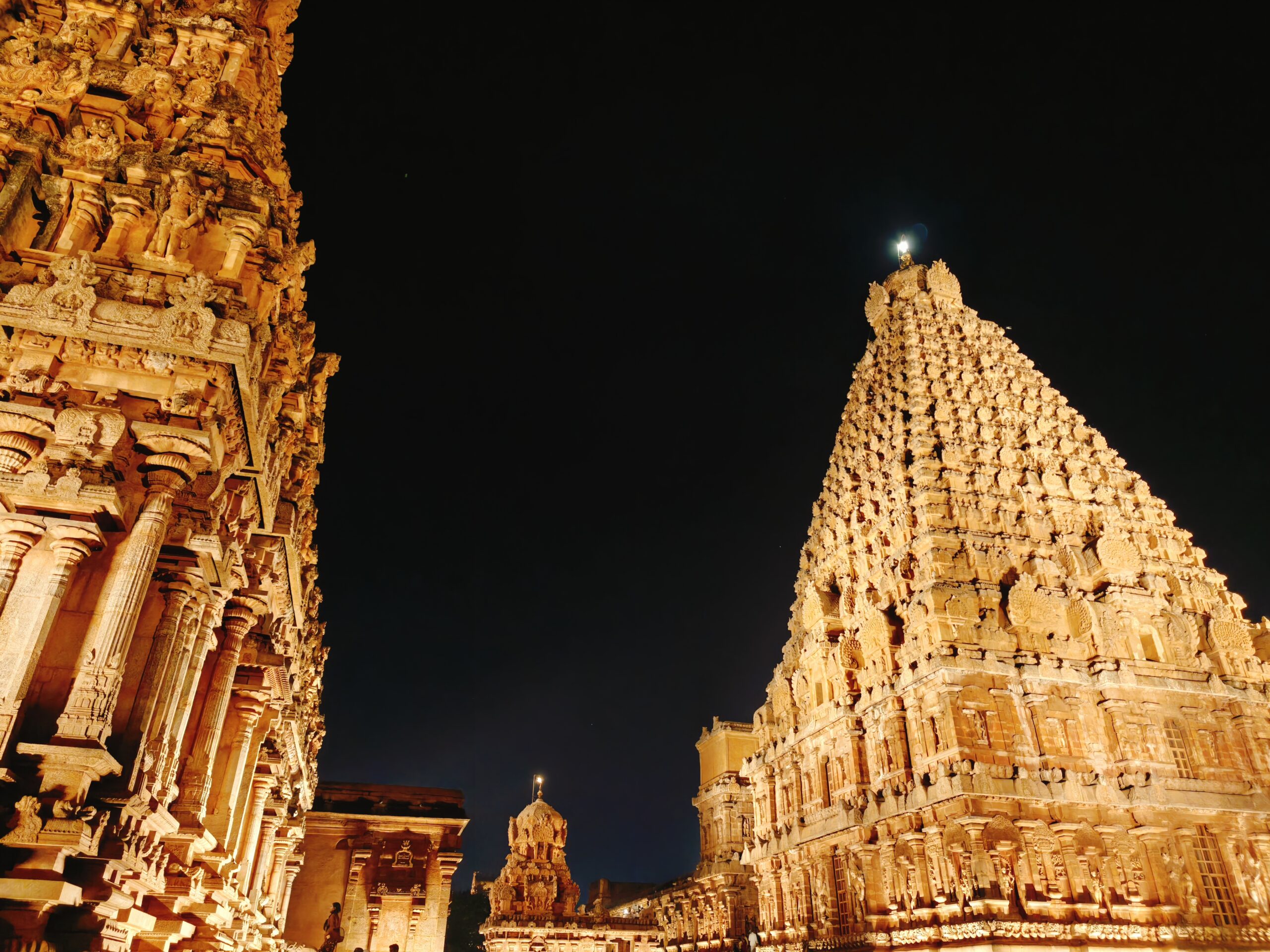
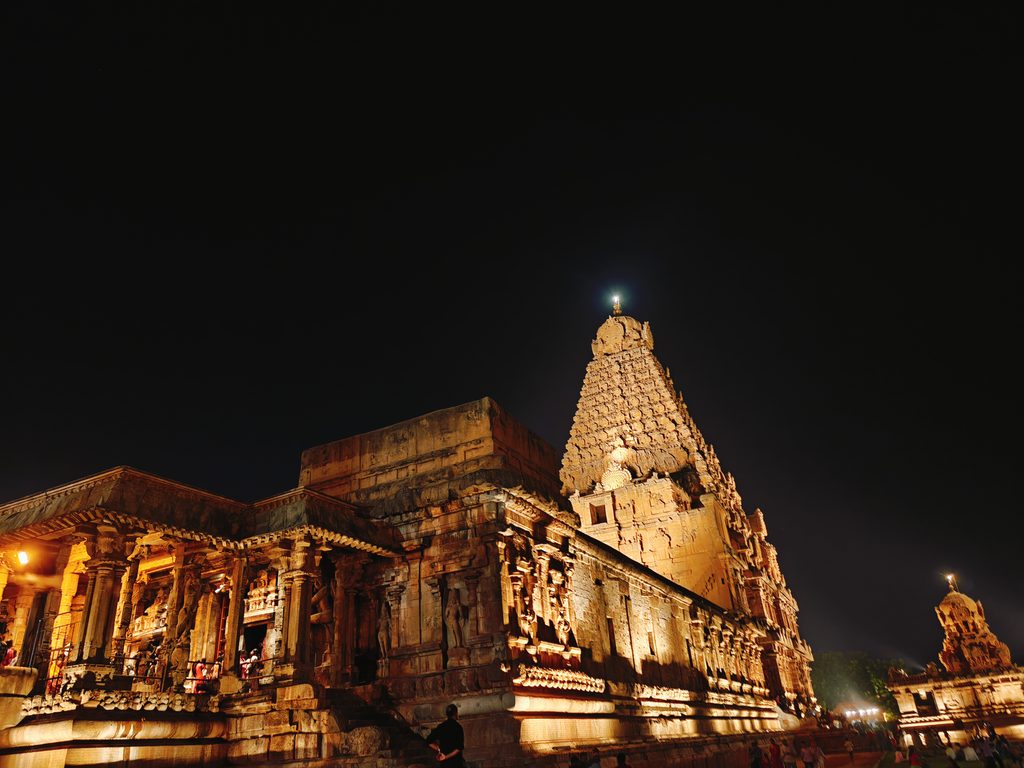
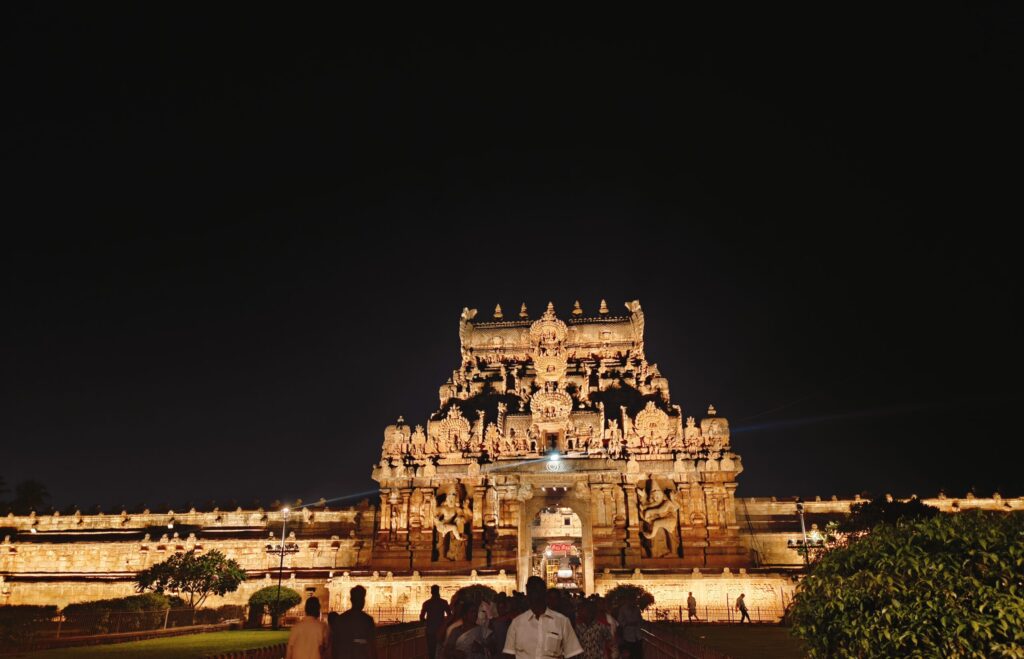
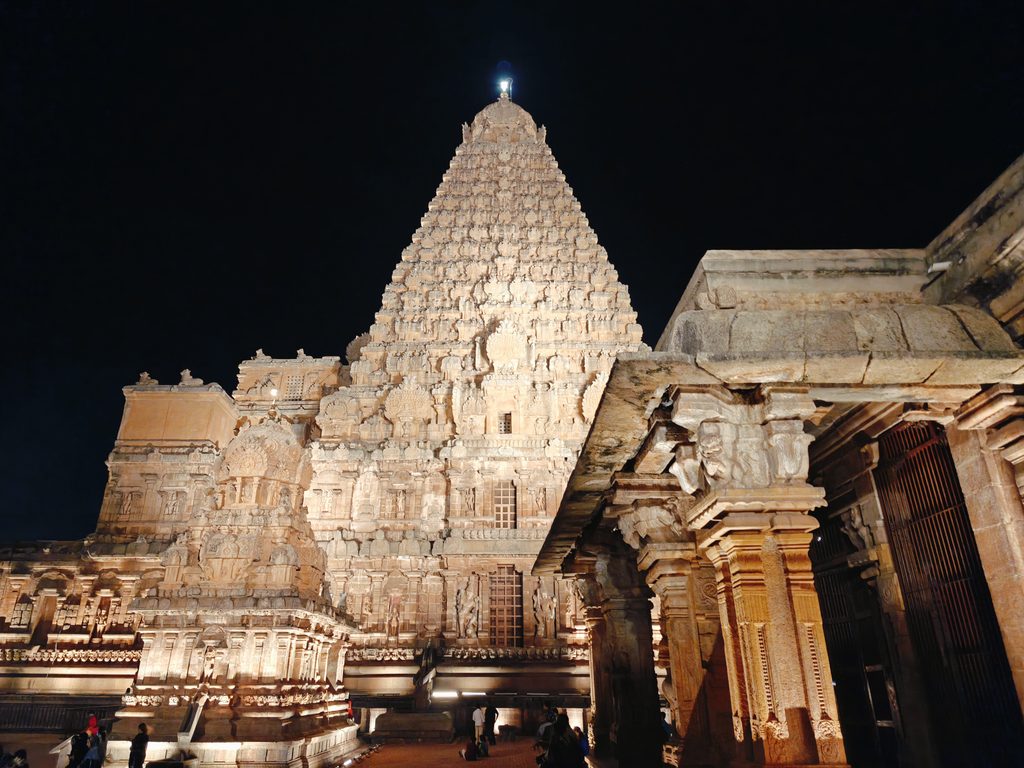
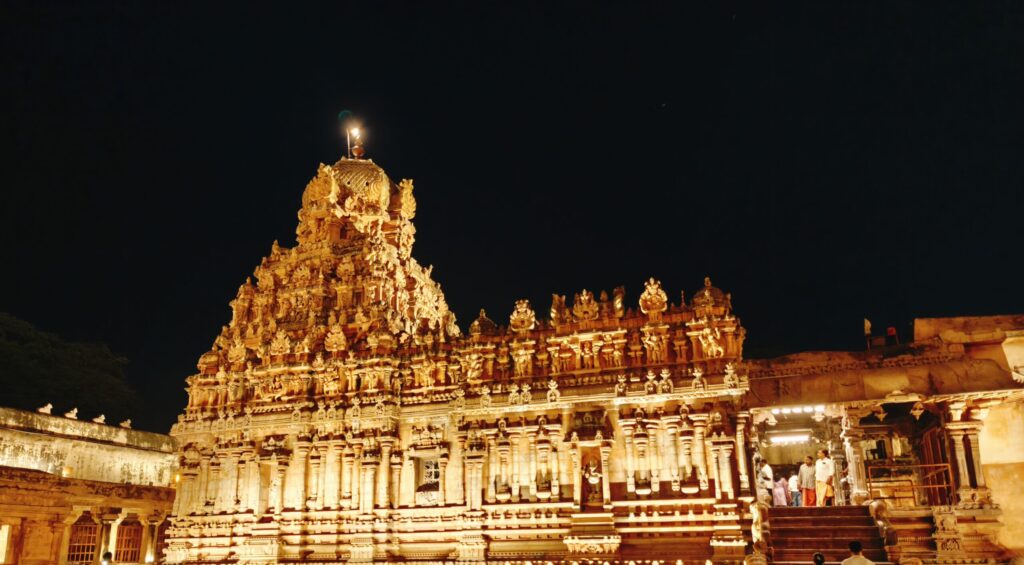
On our recent visit, we arrived in the evening to avoid the afternoon heat. We were standing opposite the main tower when, shortly after 6 PM, the temple lights suddenly came on. The entire tower glowed under the golden lights, almost as if it were made of gold. We stood there admiring it for a while. It was such a beautiful sight that we couldn’t take our eyes off it.
If you want to know why to visit the Thanjavur Big Temple, we have a lot of information to share with you.
Thanjavur Big Temple at a Glance
LOCATION | Thanjavur, Tamil Nadu
ALSO KNOWN AS | Brihadeeswarar Temple, Periya Kovil
BUILT BY | Raja Raja Chola I, around 1010 CE
DEDICATED TO | Lord Shiva
DON’T MISS | The 216-foot vimana, giant Nandi, sculptures, and ancient inscriptions
TIME NEEDED | 1.5–2 hours
ENTRY FEE | Free
BEST TIME | Early morning or evening
A Little History of Thanjavur Big Temple
To understand the history of the Big Temple, come along with me as we travel back more than a thousand years to the time of the Chola dynasty.
The Cholas were among the most powerful rulers in South India. During their rule, Thanjavur became an important capital. The Cholas were known for their military power, overseas trade, and administration, while their kingdom flourished in architecture, agriculture, art, music, and dance, and their influence extended well beyond Thanjavur.
The temple was built during the reign of Raja Raja Chola I, originally known as Arulmozhi Varman, who ruled from 985 to 1014 CE. The temple has stood the test of time. Its enormous stone tower, detailed sculptures, and ancient Tamil inscriptions tell us a great deal about the people who lived here centuries ago.
Construction is believed to have begun around 1003 CE, and the temple was completed around 1010 CE, taking approximately seven years to build.
The temple was originally known as Rajarajeswaram, named after Raja Raja Chola I, the king who built it. Today, it is known as Brihadeeswarar Temple or simply Periya Kovil, meaning “Big Temple” in Tamil, it’s the name you’ll hear most often when speaking to locals in Thanjavur.
Why Is Thanjavur Big Temple a UNESCO World Heritage Site?
In 1987, Brihadeeswarar Temple was added to the UNESCO World Heritage List for its extraordinary architecture, Chola craftsmanship, historical evidence, and living traditions. The listing was later extended to include two more Chola temples, and these three temples are known as the Great Living Chola Temples:
- Brihadeeswarar Temple, Thanjavur
- Brihadisvara Temple, Gangaikonda Cholapuram: Built by Rajendra Chola I, son of Raja Raja Chola I, around 1035 CE
- Airavatesvara Temple, Darasuram: Built by Raja Raja Chola II in the 12th century CE (around 1150–1170 CE)
All three temples are known for their remarkable architecture, sculptures, and continuing living traditions.
The word “living” is particularly meaningful. Even after hundreds of years, we come here to worship, and the temple traditions continue today.
The Architecture of Thanjavur Big Temple
There is something special about walking into Thanjavur Big Temple. You pass through the ancient stone gateways; you’ll see the enormous Nandi statue sitting in its pavilion, and suddenly an enormous tower rises before you.
When you stand in front of the tower and look all the way up, it’s hard to imagine how the Chola builders constructed something so magnificent more than a thousand years ago, without the machinery we have today.
The entrance gateways, Nandi pavilion, and main shrine are all arranged along a central line, with a wide, open courtyard surrounding them. It is only when you stand here that you begin to appreciate the size of this place. Even if you’ve seen photographs of the temple, standing in front of it is a completely different experience.
The Big Temple is one of the finest examples of Dravidian architecture in South India.
The Entrance Gateways
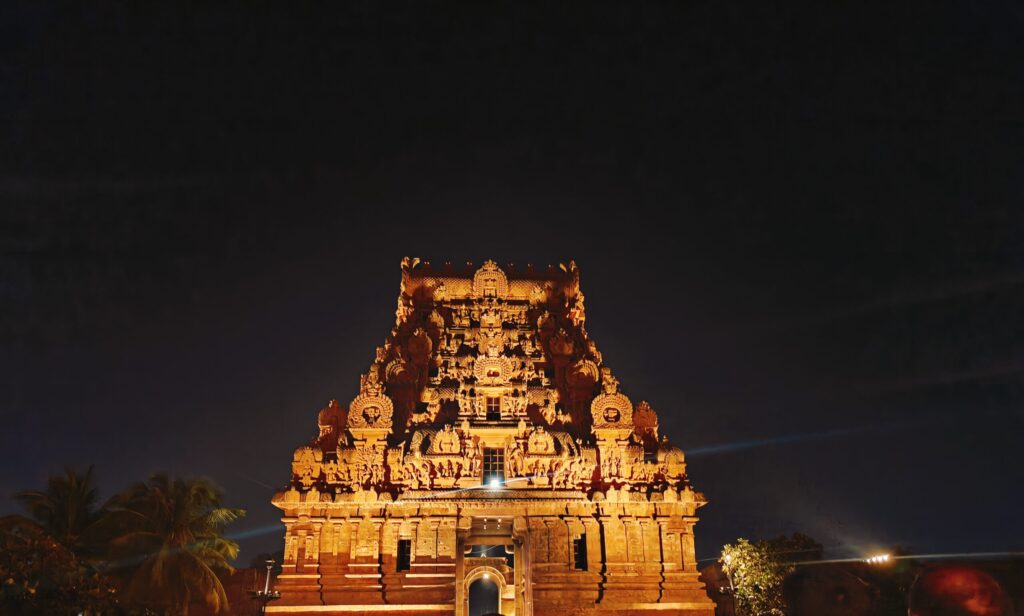
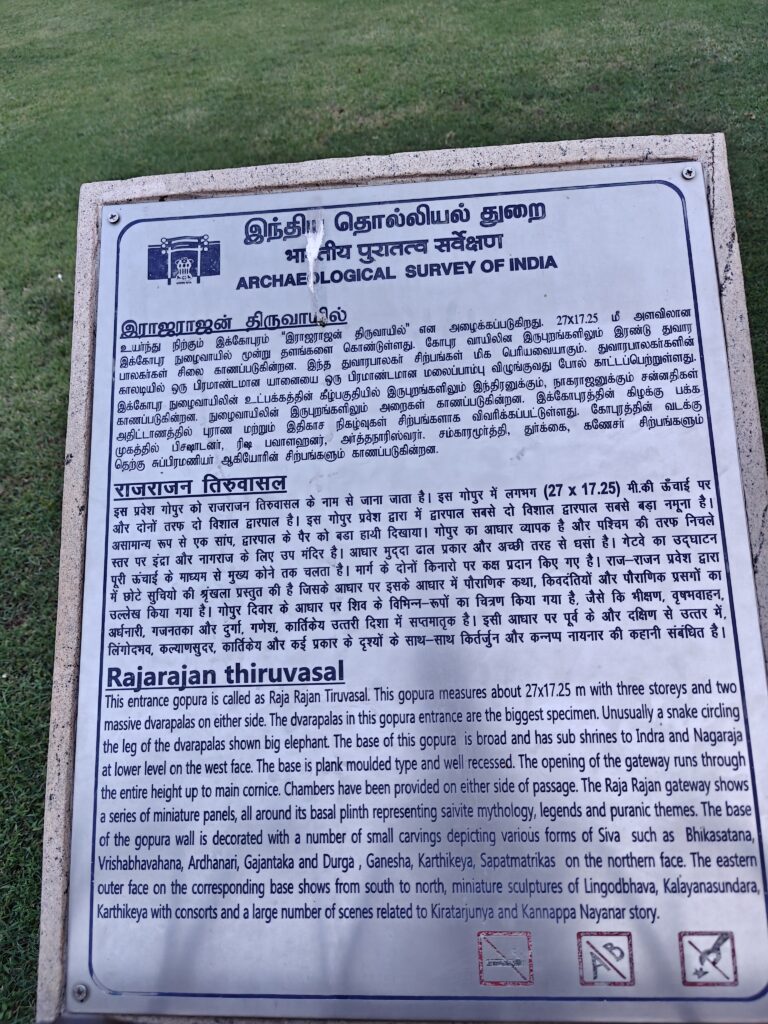
Before reaching the main courtyard, you’ll pass through two impressive entrance gateways.
The first is called Keralantakan Tiruvasal, named for Raja Raja Chola I’s victory over the Cheras.
The second is Rajarajan Tiruvasal, named after the king who built the temple.
Both gateways are decorated with beautiful stone sculptures and architectural details. Take a moment to look at the carvings as you walk through.
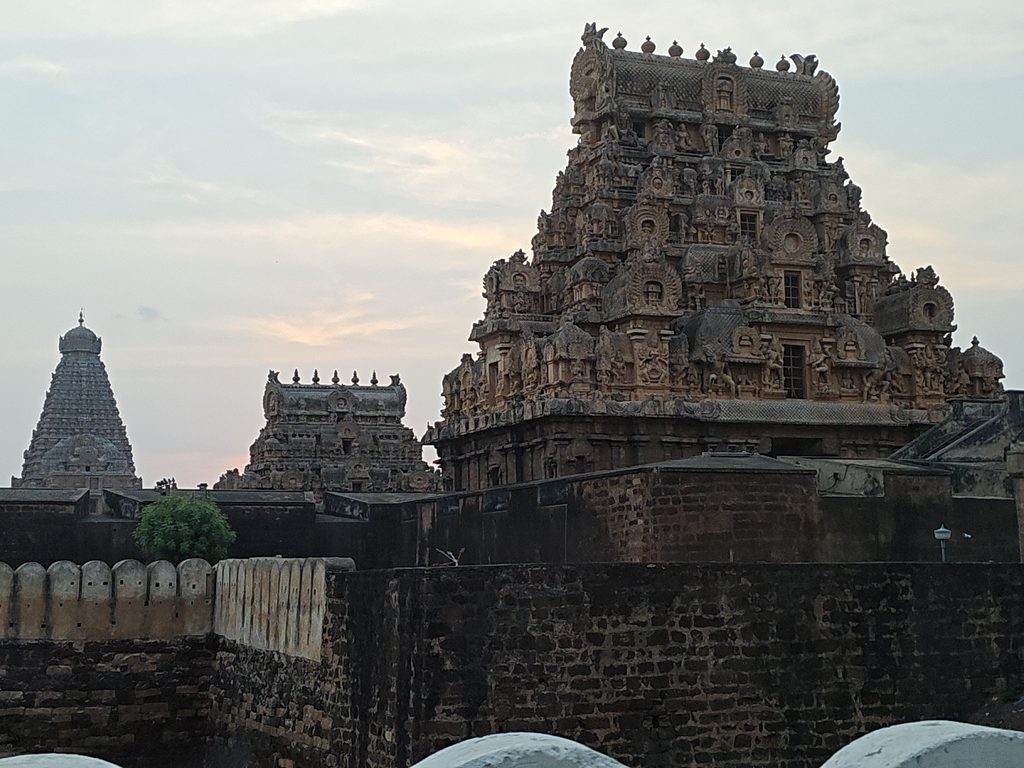
Once you pass through the gateways, the enormous vimana rises right in front of you. Seeing it closely gave us goosebumps.
The 216-Foot-Tall Vimana
The most remarkable feature of the Big Temple is its towering vimana.
The vimana is the tall tower built directly above the temple’s main sanctum (Garbhagriha). The sanctum is the sacred room inside the temple where Lord Shiva is worshipped in the form of a Shiva Lingam.
Here, the vimana rises approximately 66 meters (216 feet) above the temple complex. Unlike many South Indian temples, where the entrance gopurams dominate the skyline, the main sanctum tower is the tallest and most prominent structure here.
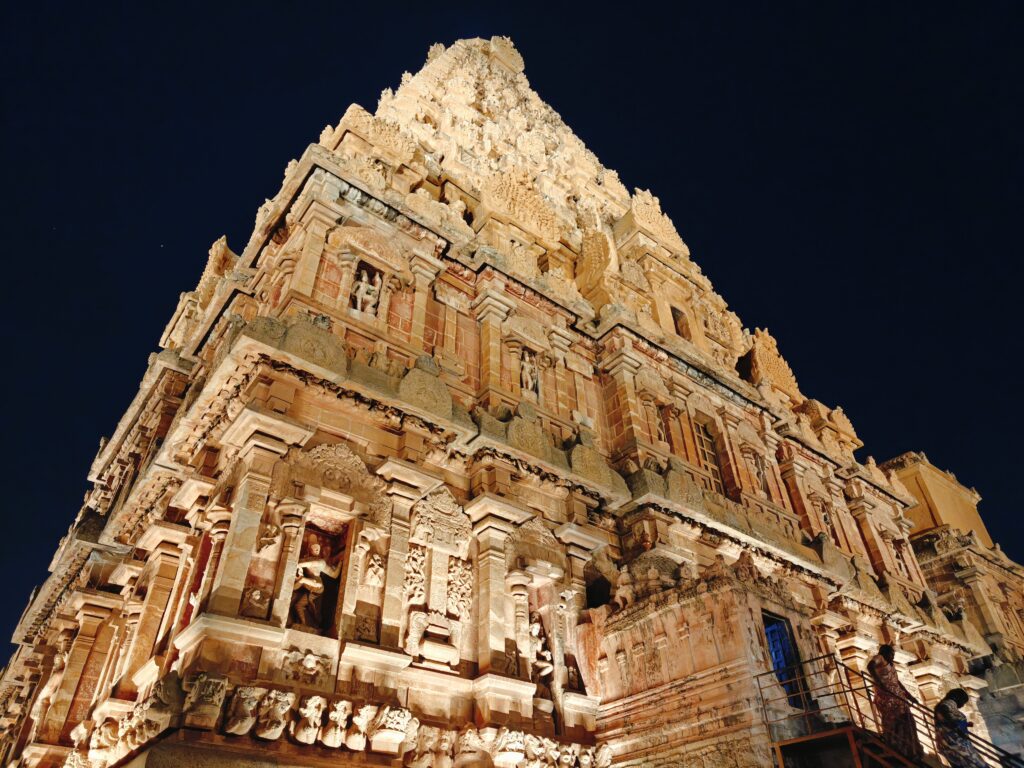
Look closely at the different levels of the vimana. Each level becomes smaller as the tower rises, creating its distinctive pyramidal shape.
You may have heard that the Big Temple’s tower never casts a shadow. This is a myth. When the sun is directly overhead, the shadow falls beneath the tower and is difficult to see. At other times, the tower casts a visible shadow.
The Shikhara
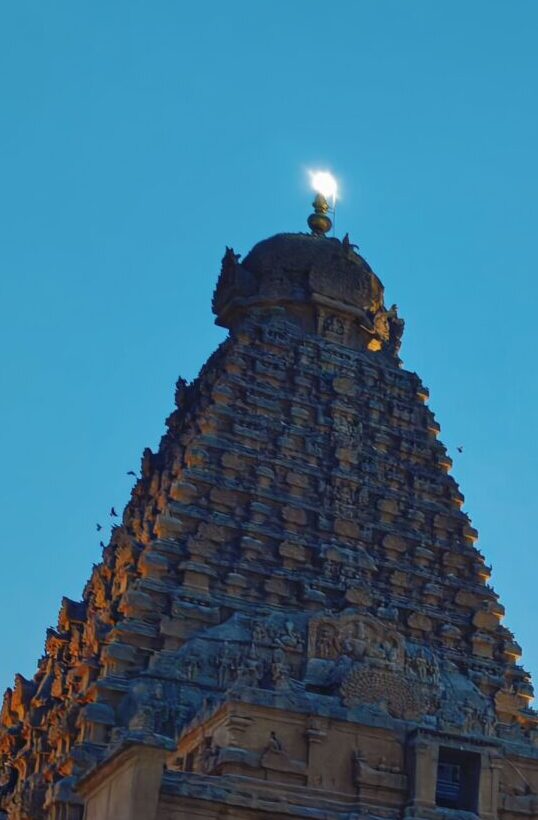
At the very top of the 216-foot-tall vimana, you’ll notice a large, rounded stone structure known as the shikhara.
Unlike the pyramidal levels below it, the shikhara has a dome-like shape. It is one of the most remarkable architectural features of the Big Temple.
The enormous granite stone associated with this upper structure is traditionally estimated to weigh around 80 tonnes (80,000 kg).
I really don’t understand how the Chola builders managed to lift and position such a massive stone at that height at that time.
My husband says the stone at the top is big enough for a bullock cart to turn around. Although this has never been proven, it’s a popular story every Tamilan tells, and I love hearing it every time.
The shikhara is crowned by a sacred metal finial called the kalasam, which has its own religious significance.
The Kalasam
Above the shikhara stands the kalasam, the sacred metal finial that crowns the temple tower.
The kalasam is approximately 12.5 feet (3.8 metres) tall. It is traditionally described as a copper structure covered with gold.
The kalasam is more than an architectural decoration. In Hindu temple traditions, it is considered sacred and represents auspiciousness and divine blessings.
In most Hindu temples, the practice of placing grains such as varagu (kodo millet) inside temple kalasams.
Grains symbolise prosperity, fertility, and abundance. Some traditions also associate storing grains inside the kalasam with preserving seeds for future generations. Varagu is a hardy millet that can be stored for long periods when kept dry.
You may also hear about Kumbabishekam, an important Hindu temple consecration or reconsecration ceremony. In Tamil Nadu, it is traditionally performed approximately once every 12 years, although the actual interval can vary.
During Kumbabishekam, special prayers and rituals are conducted, and consecrated water is poured over the temple’s kalasams.
The grains inside the kalasams may also be renewed during preparations for the ceremony. According to traditional belief, varagu grains can remain preserved for around 12 years.
How Was the Big Temple Built?
One of the most fascinating things about the Big Temple is its granite construction.
Thanjavur lies in the fertile Kaveri delta, yet the temple was built using enormous quantities of hard granite.
The Chola builders had to transport, shape, and carefully position these massive stone blocks without modern machinery.
Traditional stoneworkers used techniques to split large rocks into smaller blocks. One such method involved inserting wooden wedges into holes in the stone and soaking them with water. As the wood expanded, the pressure helped split the rock.
The precise methods used to quarry and assemble every part of the Big Temple are not fully documented, but the scale of the construction shows the remarkable skills of the Chola craftsmen.
How Was the Massive Stone Placed at the Top?
One of the biggest questions about the Big Temple is how the builders managed to raise such heavy stones to the top of its towering vimana.
One popular theory suggests that the builders constructed a long earthen ramp and used it to move heavy stones gradually upwards.
According to this theory, elephants and large teams of workers may have helped pull the massive stones along the ramp using ropes.
However, there is no conclusive historical evidence confirming exactly how the stones were lifted or whether elephants were used in this process.
Whatever techniques they used, the completed tower remains an extraordinary achievement of Chola engineering.
The Spacious Temple Courtyard
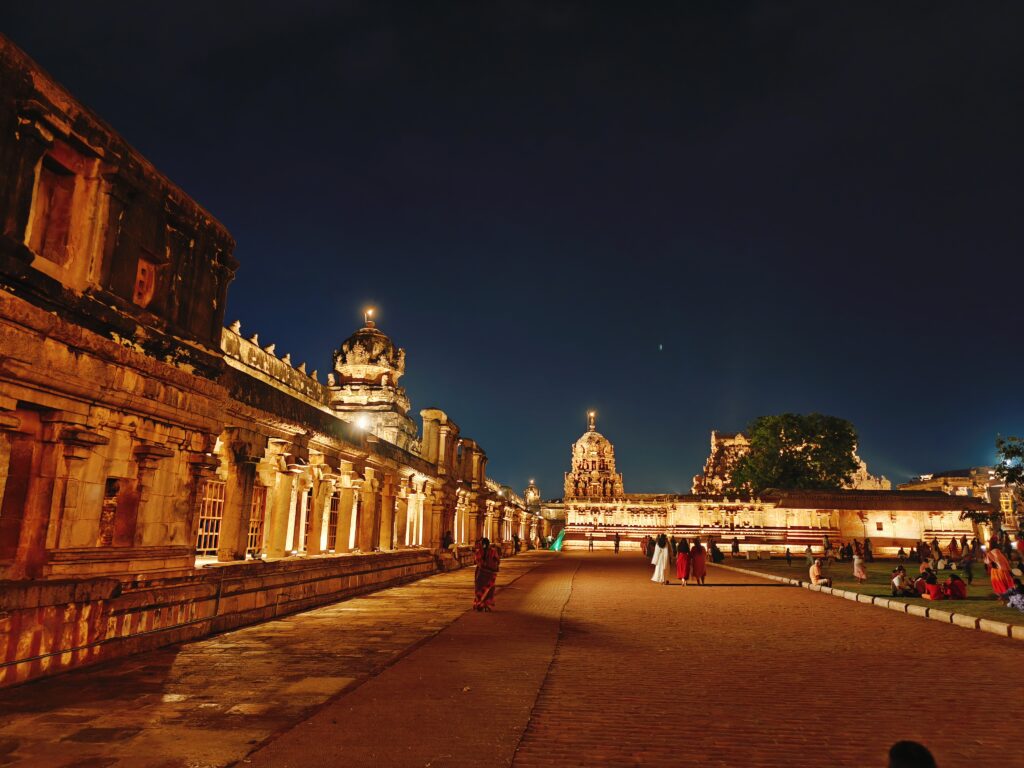
Another thing we love about the Big Temple is its spacious courtyard. The large open area gives you a clear view of the enormous vimana from different angles.
Last week, we came with our friends. Our little boy spent most of his time running around, and I got tired chasing him. We sat on the grass for almost an hour, just relaxing and chatting.
If you enjoy photography, take some time to walk around the courtyard. The tower looks different from every angle, especially as the sunlight changes throughout the day.
Things to See Inside Thanjavur Big Temple
There is much more to the Big Temple than its famous tower.
The temple complex includes beautiful gateways, a mesmerizing Nandi statue, sculptures, inscriptions, and religious structures worth exploring.
Here are the main things to look for during your visit.
The Giant Nandi Statue
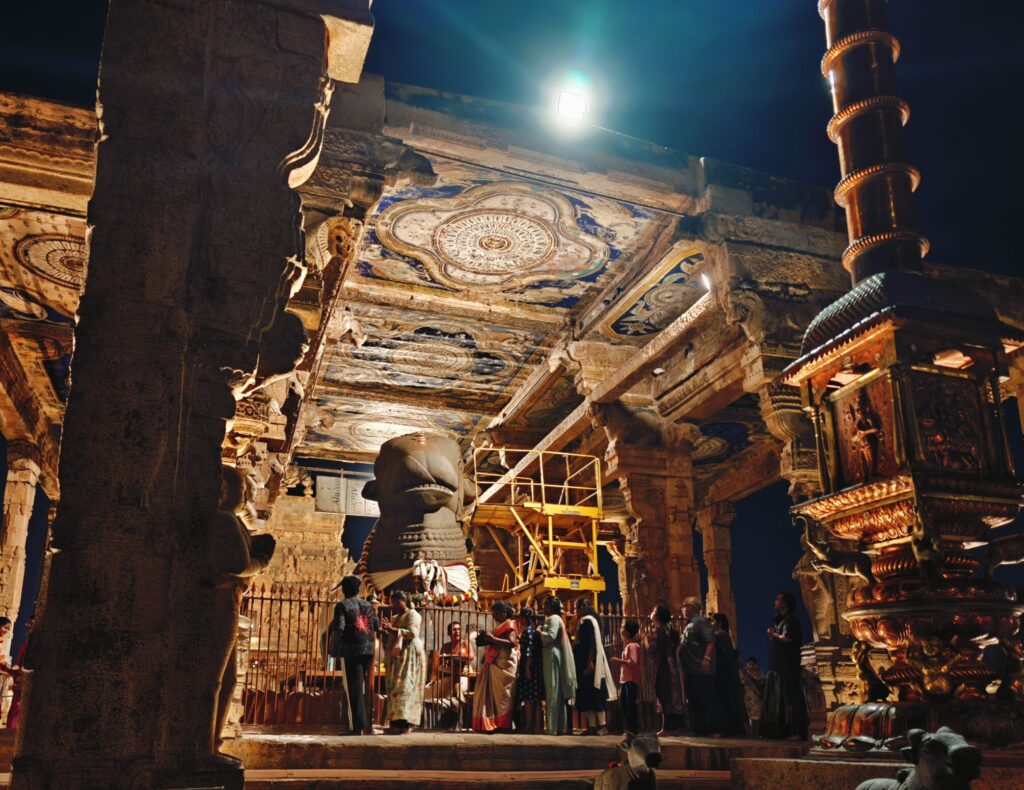
One of the first important structures you will notice is the Nandi pavilion.
Nandi, the sacred bull associated with Lord Shiva, traditionally faces Shiva’s sanctum.
At the Big Temple, the enormous stone Nandi sits inside a beautifully decorated pavilion directly opposite the main shrine.
Just take a moment to notice the alignment between the Nandi statue and the temple tower. This is one of the most recognizable features of the temple complex.
The Kodimaram (Temple Flagstaff)
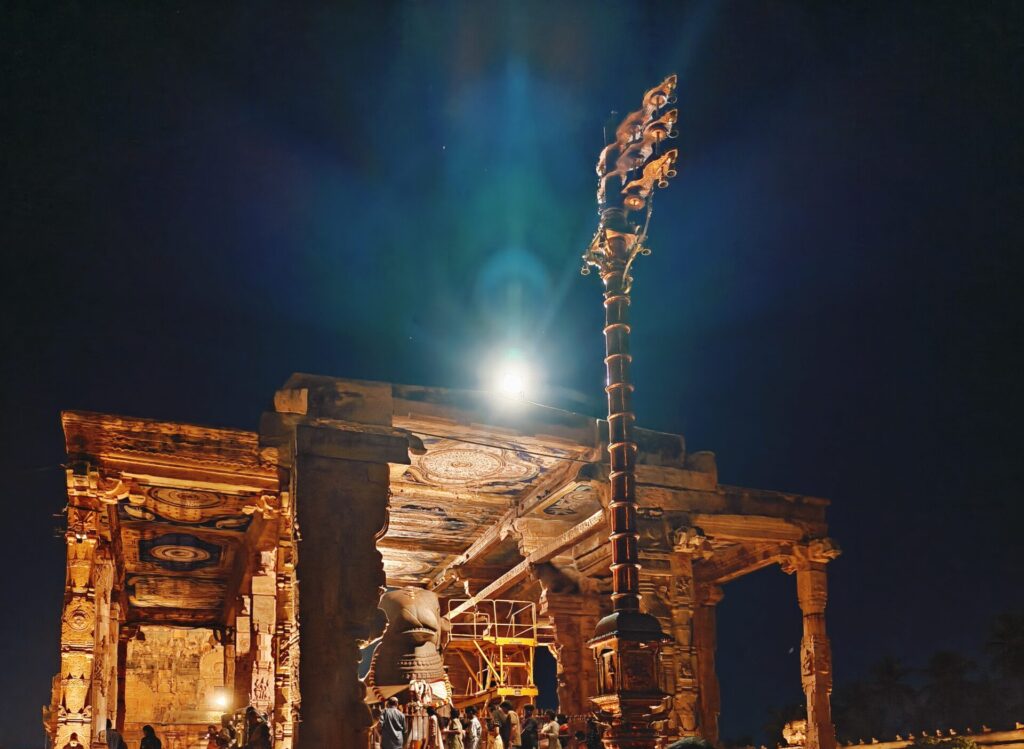
Another feature to look for is the Kodimaram, or temple flagstaff, located along the central approach to the main shrine.
In Hindu temples, the flagstaff plays an important role during religious festivals. A ceremonial flag is raised to mark the beginning of certain temple celebrations.
It’s easy to walk past without knowing its significance, especially when your attention is drawn to the enormous Nandi statue and vimana.
The Dwarapalakas
As you approach the Lord Shiva, you’ll notice enormous stone figures standing on either side of the entrance.
These are called Dwarapalakas, the guardian deities. Traditionally, they stand at temple entrances to guard spaces. Their huge figures, expressive faces, and detailed ornaments are wonderful examples of Chola stone sculpture.
The Main Shiva Lingam
The main sanctum is dedicated to Lord Shiva, who is worshipped here in the form of a large Shiva Lingam.
The Shiva Lingam stands approximately 13 feet (4 metres) tall, making it one of the largest Shiva Lingams in India.
For devotees, this is the most important part of the temple. Darshan is the Hindu practice of seeing and paying respects to a deity.
As this is an active place of worship, remember to follow the temple’s instructions and give worshippers space during rituals.
The Pillayar and Murugan Shrines
As you enter the Big Temple, you’ll come across a shrine dedicated to my favorite Lord Ganesha.
The temple complex also has a beautiful shrine dedicated to Lord Murugan. Both Ganesha and Murugan are sons of Lord Shiva and Goddess Parvati.
The Murugan shrine was added during the Nayaka period, much later than the original Chola temple. It is particularly worth seeing for its beautifully carved stone pillars and detailed sculptures.
The Periya Nayaki Amman Shrine
The Big Temple also has a separate shrine dedicated to Goddess Parvati, worshipped here as Periya Nayaki Amman (Brihannayaki).
Raja Raja Chola I built the main Shiva temple, while the present Periya Nayaki Amman shrine was constructed centuries later.
The Varahi Amman Shrine
Varahi Amman is one of the deities worshipped at Thanjavur Big Temple. She is a form of the Divine Mother, traditionally depicted with the face of a boar.
Raja Raja Chola I worshipped Varahi Amman and sought her blessings before going into battle. This is a belief passed down through generations
Varahi Amman is considered a very powerful goddess by her devotees. Special poojas are performed in her honour, and many devotees visit the shrine to seek her blessings and protection.
The Shiva Lingams Around the Temple
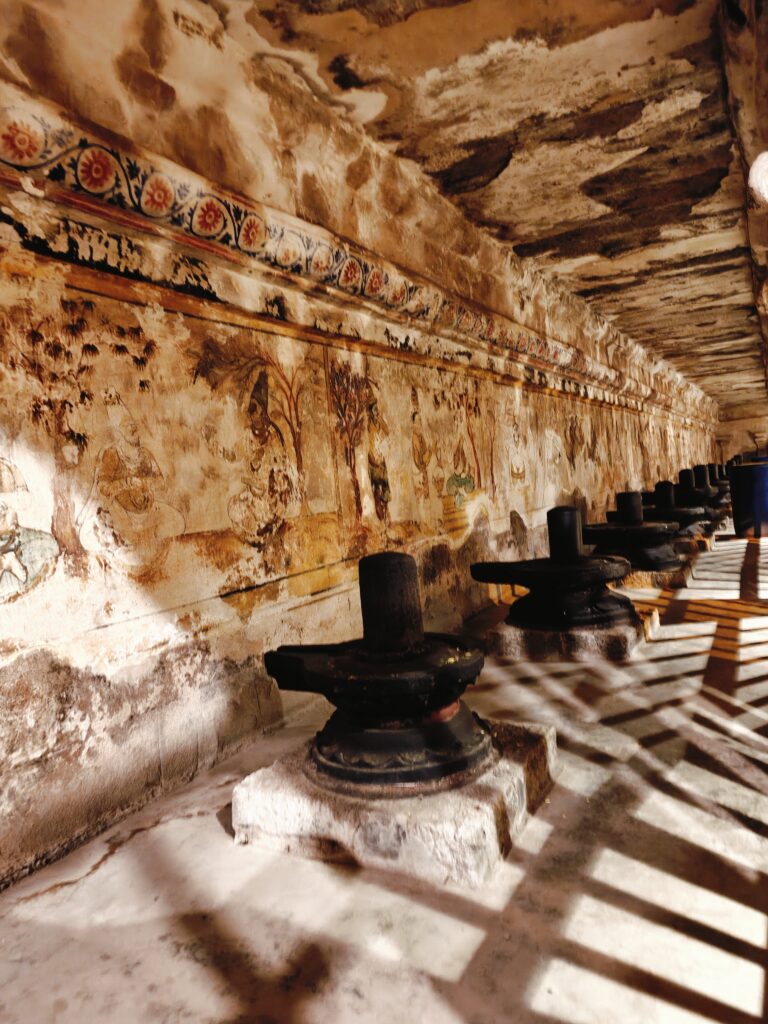
Apart from the enormous Shiva Lingam in the main sanctum, you’ll find rows of smaller Shiva Lingams along the corridors surrounding the temple.
There are hundreds of Shiva Lingams within the temple complex, arranged in long rows.
During our visit, our guide also pointed out the paintings and sculptures around this area. He explained that some of the fresco paintings were created during the Maratha period in the 18th century.
He showed us a depiction of Gajalakshmi, Goddess Lakshmi accompanied by elephants. He explained that you can often identify deities by looking at the objects they hold in their hands.
Even the jewellery, clothing, and ornaments shown in paintings and sculptures can offer clues about the period in which they were created.
We had walked past details like these on earlier visits without knowing their significance. Having someone explain them made us look at the temple a little differently.
The Stone Sculptures
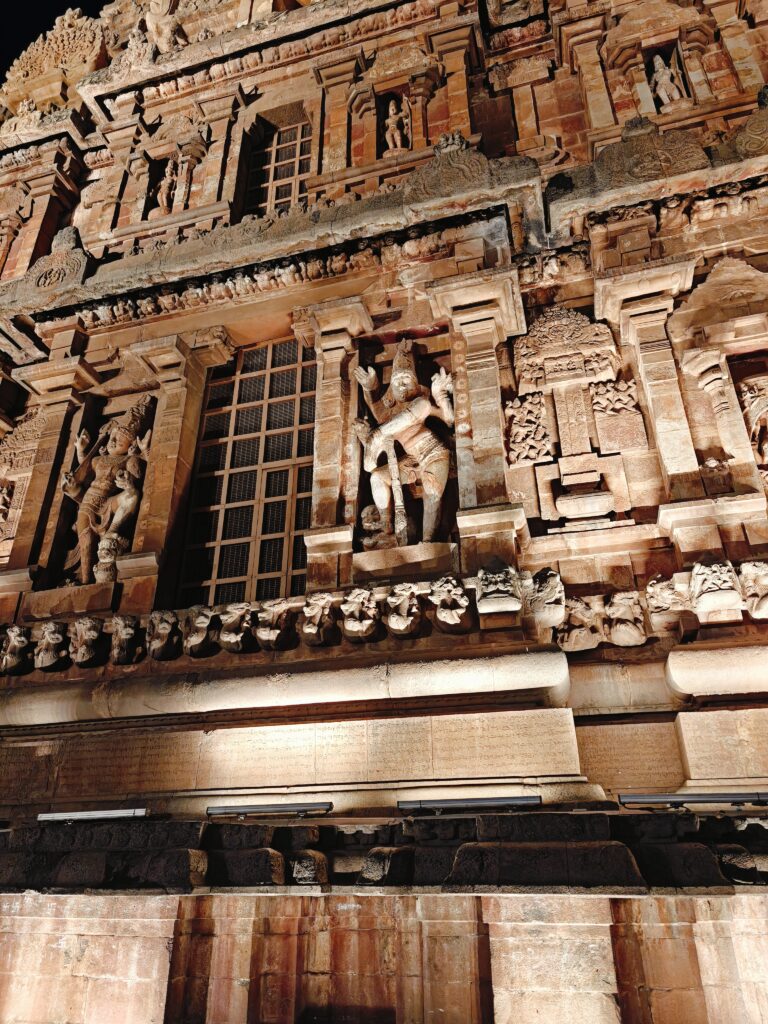
The exterior walls of the temple are filled with beautiful stone sculptures.
You will find carvings of Hindu deities, decorative patterns, and architectural details throughout the complex.
Some of these sculptures are placed in niches along the walls of the main temple.
The carvings are not simply decorative here. They also reflect the religious beliefs and artistic traditions of the Chola period.
The Ancient Tamil Inscriptions
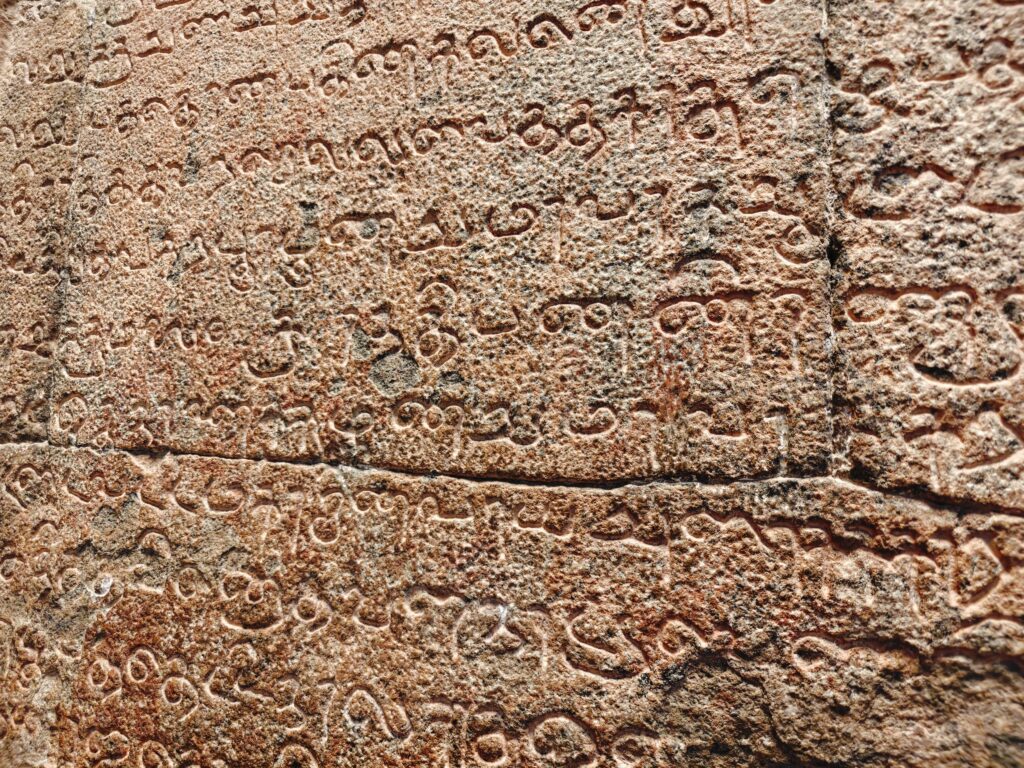
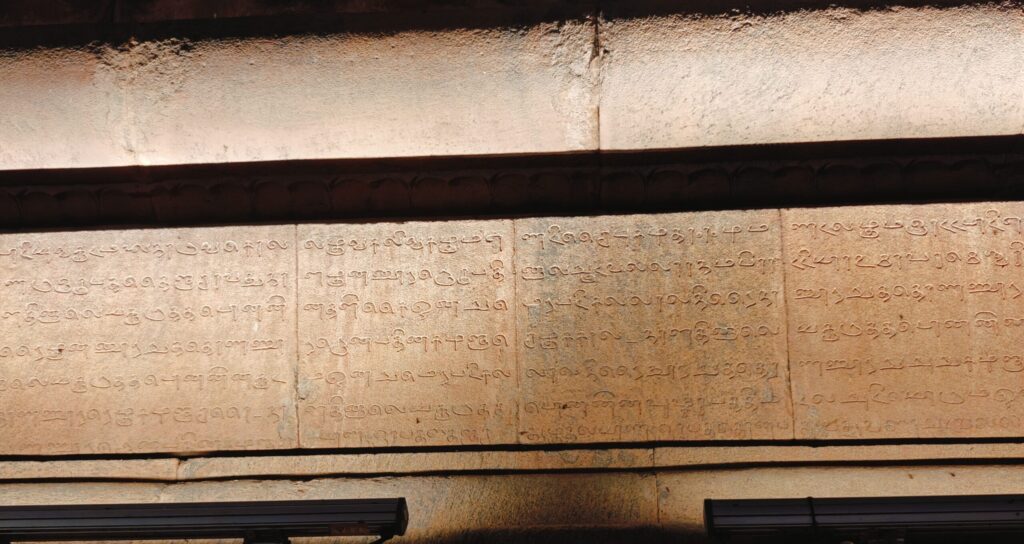
One of the most interesting things about the Big Temple is its ancient Tamil inscriptions.
These writings were carved directly into the stone during the Chola period. They record royal donations, religious activities, and details about how the temple was managed.
During our visit, our guide showed us one of the inscriptions and read a few lines aloud. He explained that Raja Raja Chola I had recorded not only his own contributions but also donations made by sisters, his queens, and others.
One phrase that caught our attention was “Naam eduppitha”, referring to the temple he had built. Our guide pointed out that the king used naam (we) rather than naan (I).
It was interesting to hear those words explained while standing in front of the stone on which they were carved more than a thousand years ago.
While the tower and sculptures show us what the Chola builders created, these inscriptions tell us about the people who lived and worked during that time.
The Chola Paintings
The Big Temple is also home to paintings dating back to the Chola period.
Some of these paintings are found in the narrow passage around the main sanctum. They depict Lord Shiva, religious stories, and scenes from the Chola period.
Over time, some of the original Chola paintings were covered by paintings created during the Nayaka period. Both layers give us a glimpse of the art and traditions of different centuries.
These are just some of the main things to see at Thanjavur Big Temple. There are several other shrines dedicated to Hindu gods and goddesses throughout the complex. If you have time, walk around and explore them too.
Sadhaya Vizha: Celebrating Raja Raja Chola’s Birthday
Every year, Thanjavur celebrates Sadhaya Vizha, the birth anniversary of Raja Raja Chola I, the king who built the Big Temple.
The festival takes place during the Tamil month of Aippasi (usually October or November), on the day associated with his birth star, Sadhayam. Special prayers and celebrations are held at the temple, drawing visitors and devotees from different places.
During our visit to Thanjavur in October 2026, Sadhaya Vizha celebrations were taking place. I really wanted to attend the celebrations. But we had our little boy with us, and knowing how crowded the temple would be, we decided to skip it this time.
I was a little disappointed, but sometimes travelling with a young child means making practical decisions. Hopefully, we’ll get to experience Sadhaya Vizha on another visit.
If you’re planning to visit during the festival, expect larger crowds than usual, especially around the main temple.
How to Visit Thanjavur Big Temple
Thanjavur Big Temple Opening Hours
Thanjavur Big Temple is generally open from 6:30 AM to 8:30 PM.
For Lord Shiva, they may have separate darshan and pooja timings. If you’re planning to visit in the afternoon or attend a particular pooja, check with the temple office before you go.
Entry Fee
Entry to Thanjavur Big Temple is free for everyone. You don’t need to buy a ticket to explore the temple complex.
How Much Time Do You Need at Thanjavur Big Temple?
We recommend spending around 1.5 to 2 hours exploring the Big Temple.
If you’re interested in history and architecture, you could easily spend longer, especially with a local guide. There are plenty of sculptures and inscriptions to discover as you walk around.
If you’re planning to have darshan, allow some extra time for the queue, especially during weekends and festivals.
Best Time to Visit Thanjavur Big Temple
The best time to visit Thanjavur is from October to February, when the weather is generally more comfortable for sightseeing.
Thanjavur gets very, very hot during the summer, so we recommend visiting the Big Temple early in the morning or later in the afternoon.
Morning is a good choice if you want to explore the architecture and take photographs in daylight.
We personally prefer visiting in the evening. If you have the time, we recommend arriving before sunset so you can admire the temple in daylight and stay to see the enormous vimana illuminated after dark.
Tips for Visiting Thanjavur Big Temple
- Dress respectfully and comfortably. You can wear modest clothing that respects the temple’s religious traditions. Lightweight cotton clothes are a good choice during Thanjavur’s warmer months.
- Be prepared to remove your footwear. You can leave your footwear at the designated counter just after the first gateway, and remember that the stone floors can get hot during the day.
- Carry drinking water. The courtyard is spacious; you’ll get tired from walking around the temple. Carry water bottles and stay hydrated.
- Hire a local guide if you’re interested in history. A guide can help you understand the stories behind the temple’s sculptures, inscriptions, and architecture.
Can You Take Photos Inside the Big Temple?
We took plenty of photos around the open courtyard, where you get lovely views of the enormous vimana from different angles, but we didn’t take any inside the main sanctum. For us, that’s a place to put our cameras away and focus on offering our prayers.
Photography rules may vary in different parts of the temple, so check the signs and follow the instructions given by the temple staff.
How to Reach Thanjavur Big Temple
Thanjavur is well connected by road and rail, making it easy to visit from other parts of Tamil Nadu.
By Air
The nearest airport is Tiruchirappalli International Airport, approximately 55–60 km from the Big Temple. From the airport, you can hire a taxi to Thanjavur.
By Train
Thanjavur Junction railway station is approximately 2 km from the temple. Auto-rickshaws and taxis are available outside the station.
By Road
Thanjavur is easily accessible by road from Trichy, Kumbakonam, and other nearby towns.
If you’re exploring Tamil Nadu by car, you can include the Big Temple in your road trip.
If you love exploring Tamil Nadu’s history and architecture, Karaikudi is another place worth visiting. Its grand Chettinad mansions, traditional houses, and local food offer a different experience from Thanjavur. Check out our Karaikudi Travel Guide to plan your trip.
Map of Thanjavur Big Temple
Thanjavur Big Temple is located in the heart of Thanjavur, Tamil Nadu. Use the map below to find its exact location and plan your visit.
How to Use This Map: Click the menu icon in the top left corner to see all the places marked on the map. You can turn individual layers on or off to focus on the area or route you want to explore. Click any marker for more information about that stop.
For a larger view, click the icon in the top right corner. To save the map for your trip, sign in to your Google account and click the star beside the map’s title. This makes it easier to find again when you need it.
Frequently Asked Questions
Who built Thanjavur Big Temple?
The Big Temple was built by Raja Raja Chola I, one of the most important rulers of the Chola dynasty. It was completed and consecrated around 1009–1010 CE.
How old is Thanjavur Big Temple?
The temple is more than 1,000 years old. It dates to the early 11th century CE.
What is the original name of Thanjavur Big Temple?
The temple was historically known as Rajarajeswaram and is associated with Raja Raja Chola I. It is now commonly called Brihadeeswarar Temple or Periya Kovil.
Is Thanjavur Big Temple free to visit?
Yes. General entry to the temple is free.
How long does it take to visit Thanjavur Big Temple?
Allow at least 1.5–2 hours to explore the main attractions. Visitors interested in architecture and history may prefer 2–3 hours.
Can foreigners visit Thanjavur Big Temple?
Yes. International visitors can explore the temple’s permitted public areas. As it remains an active religious site, everyone should follow the current temple rules and respect worshippers.
Is Thanjavur Big Temple worth visiting?
Absolutely. Its enormous stone tower, ancient inscriptions, sculptures, and rich Chola history make it one of Tamil Nadu’s most important heritage attractions.
Pin it for later!
Save this Thanjavur Big Temple guide on Pinterest for planning your visit.
Save to Pinterest
Do you have any questions about visiting Thanjavur Big Temple? Let us know in the comments below.