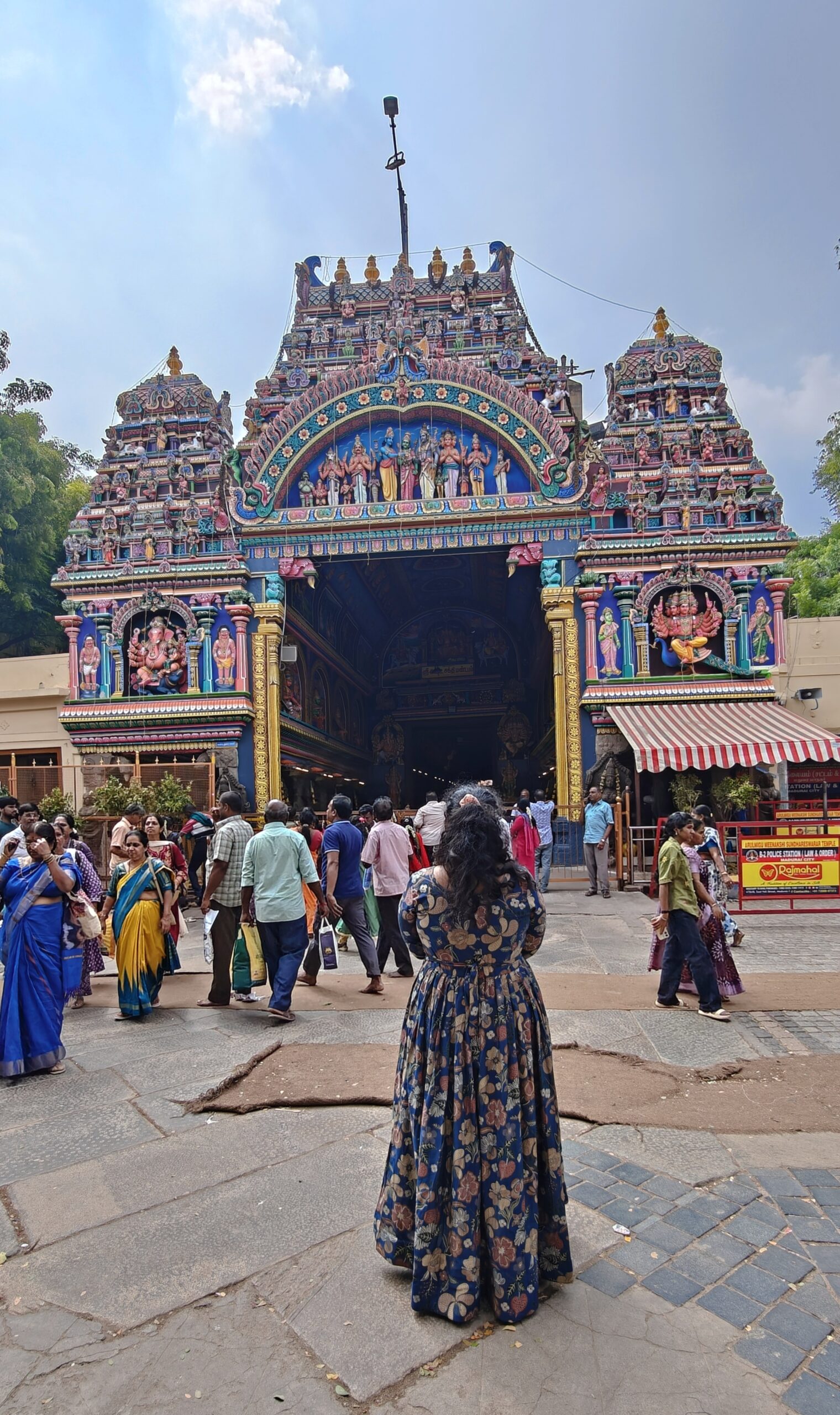
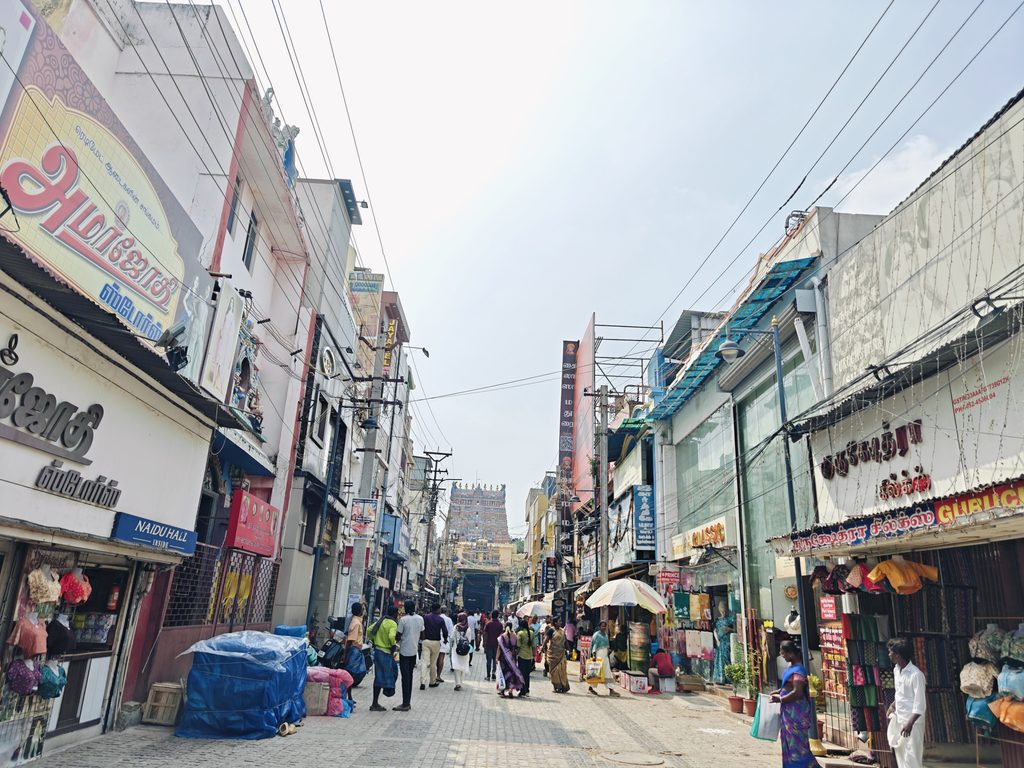
It is almost impossible to visit Madurai without noticing Meenakshi Amman Temple. Its colourful towers rise above the busy streets, and the closer you get, the more impressive they become.
When we visited, the streets around the temple were packed with shops, vehicles, and people. There was so much happening around us, but the temple towers were what caught our attention.
I had seen pictures of Meenakshi Amman Temple before, but standing there and looking at those towers was a different experience.
And there’s much more to this temple than what you see from outside. Behind its beautiful architecture are centuries of history and stories that have been passed down through generations.
In this guide, I’ll take you through the temple’s history, the places worth seeing inside, our visiting experience, and the practical details you need to plan your own visit.
Meenakshi Amman Temple at a Glance
LOCATION | Madurai, Tamil Nadu
OFFICIAL NAME | Arulmigu Meenakshi Sundareswarar Temple
MAIN DEITIES | Goddess Meenakshi and Lord Sundareswarar
ARCHITECTURE | Dravidian
TIMINGS | 5:00 AM – 12:30 PM and 4:00 PM – 10:00 PM
TIME NEEDED | 2–4 hours or longer during busy periods
MAJOR FESTIVAL | Chithirai Festival
BEST TIME | November to February
Our Experience at Meenakshi Amman Temple
We visited Meenakshi Amman Temple in November, just two days after Deepavali. The weather was surprisingly pleasant, which made our trip to Madurai much more comfortable.
We reached the temple around 8 AM. Before entering, we left our mobile phones and cameras at the storage counter and received a token to collect them later.
We bought the ₹100 special darshan tickets, thinking we could avoid the long queues. But we were wrong! Even with those tickets, we ended up waiting for almost four hours.
By the time we reached the sanctum, we were exhausted. But seeing Goddess Meenakshi so beautifully decorated made the long wait feel worthwhile.
We only had a few moments in front of her before we had to move along. Of course, I wished we could have stayed a little longer, especially after waiting for so many hours.
Still, we were happy to have her darshan.
We left the temple tired, but happy that we had made the visit.
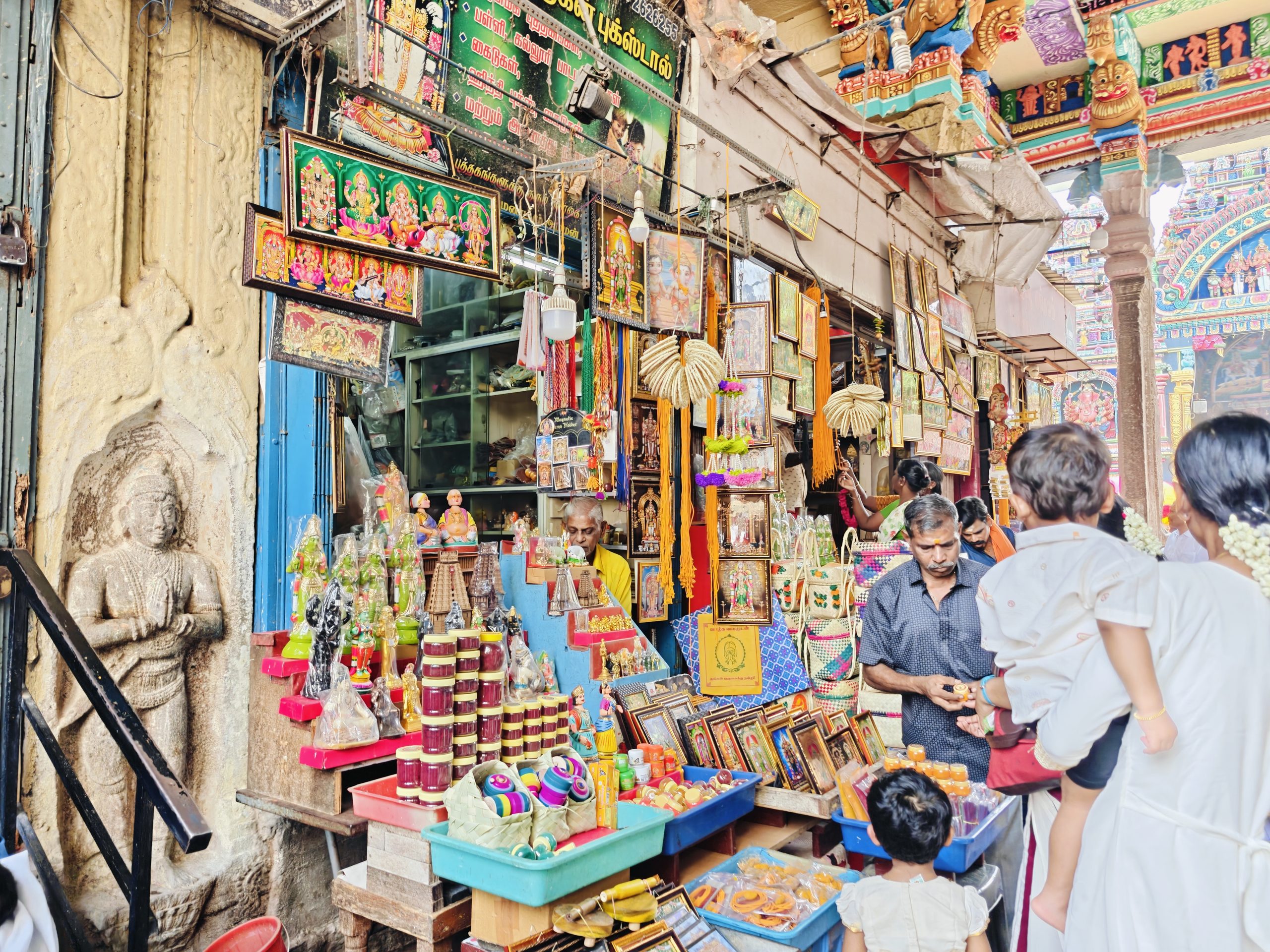
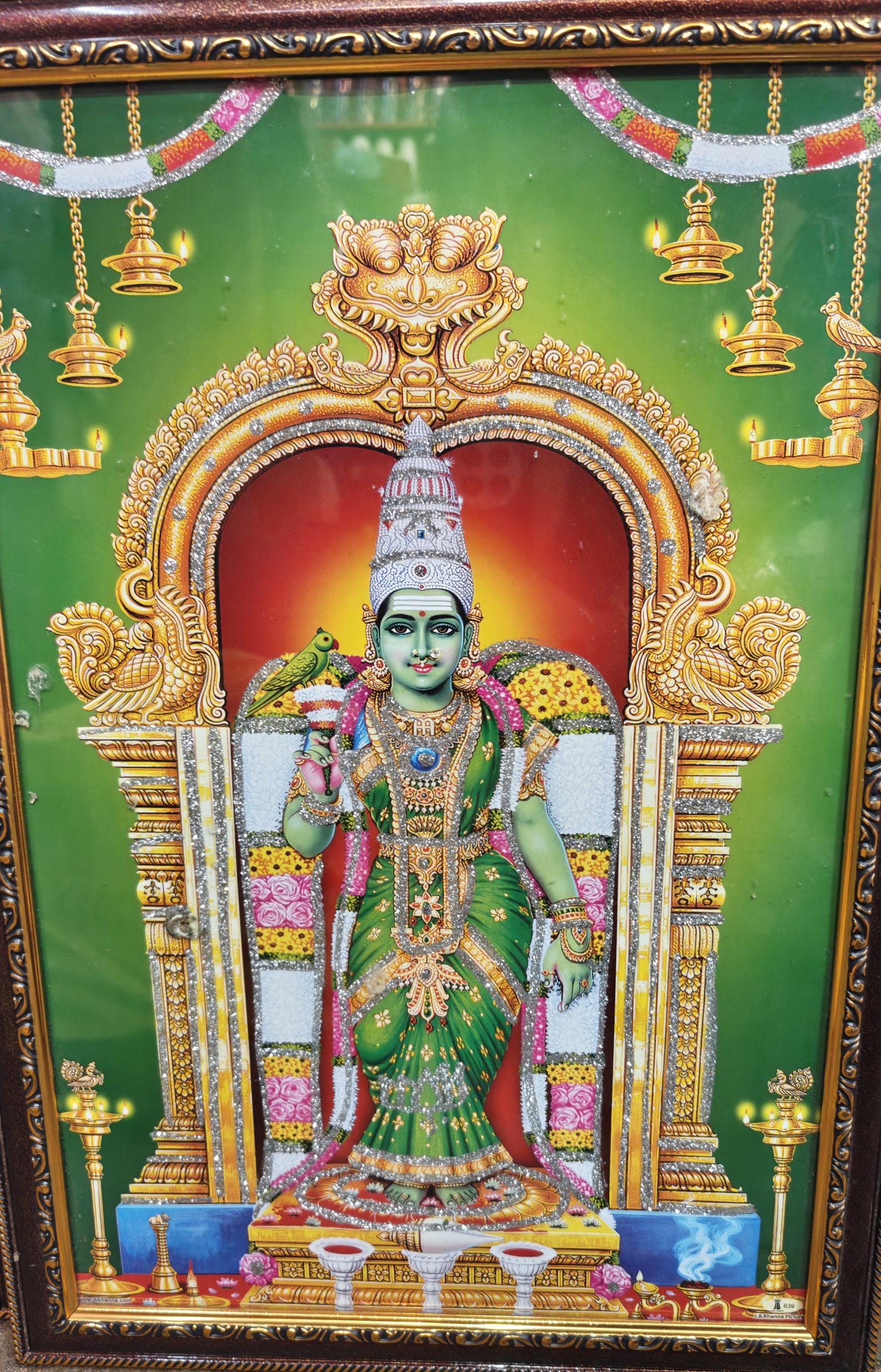
Before heading home, we stopped at a little shop near the temple and bought some bangles and a photo frame. I love bringing home little things from the places we visit, and these were lovely reminders of our day in Madurai.
History of Meenakshi Amman Temple
Madurai is one of those cities where history is difficult to separate from Maduraians’ everyday life. The streets, festivals, markets, and even the names of neighbourhoods have connections to Meenakshi Amman Temple.
To understand the temple we see today, we need to go back several centuries.
Its beginnings are wrapped in sacred legends, while its later history takes us through the Pandya kings, a devastating period of invasions, the Vijayanagara Empire, and the Nayak rulers who gave much of the temple its present appearance.
The temple is often described as being more than 2,000 years old. That refers to its long religious history, not the age of every building we see today. Much of the magnificent architecture belongs to the sixteenth and seventeenth centuries.
This history section will be a little longer, but I think it’s worth reading if you want to understand the temple beyond its beautiful architecture. I’ve tried to keep it as short as possible without leaving out the stories and events that shaped Meenakshi Amman Temple over the centuries.
To understand how the temple became what it is today, we have to begin with a forest.
Kadambavanam: The Forest Before Madurai
Long before Madurai became a busy city, its sacred origin story describes this land as a forest filled with Kadamba trees, known as Kadambavanam.
The story begins with Indra, the king of the devas.
Indra had killed Vritra, a powerful asura who had blocked the flow of water. Although Indra defeated him and released the waters, the act left him burdened with sin, so he travelled from one sacred place to another seeking forgiveness, searching for relief, until he arrived at Kadambavanam.
There, beneath a Kadamba tree, he discovered a Swayambhu Lingam — a Shiva Lingam understood to have appeared naturally rather than having been made by human hands.
Indra worshipped Lord Shiva at the spot and was freed from his burden.
This story also connects Indra with Potramarai Kulam, the Golden Lotus Pond that remains one of the temple’s important sacred spaces.
But how did a shrine hidden in a forest become the centre of a great city?
That brings us to a merchant named Dhananjaya.
The Merchant Who Changed Madurai’s Story
Dhananjaya was travelling through Kadambavanam when he stopped there for the night.
During his stay, he discovered the sacred Lingam and witnessed divine worship taking place in the forest.
When he returned, he shared what he had seen with the Pandya king, Kulasekara Pandyan.
The king subsequently received a dream in which Lord Shiva instructed him to establish a temple at the sacred spot and develop a city around it.
Kulasekara Pandyan cleared the surrounding forest, established the shrine, and began building the settlement.
And so, in Madurai’s sacred story, the city grew around the temple rather than the temple being built inside an existing city.
There is another beautiful detail to this story.
When the city was established, Lord Shiva blessed it with drops of divine nectar from his hair. The nectar was sweet, and the Tamil word madhuram means sweetness.
This is the story we grew up hearing from our grandparents about how Madurai got its name.
These stories have been passed down for generations and remain an important part of Madurai’s temple traditions. While they tell us how the temple is believed to have begun, Madurai’s actual history goes back many centuries.
The Birth of Goddess Meenakshi
Of all the stories connected with the temple, the birth of Goddess Meenakshi is perhaps the most fascinating.
King Malayadhwaja Pandyan and Queen Kanchanamala ruled Madurai, but they had no children.
Longing for an heir, they performed a sacred ritual. During the ceremony, a young girl appeared from the sacrificial fire.
She was no ordinary child.
The princess was born with three breasts, and a divine voice announced that the third would disappear when she met the man destined to become her husband.
The royal couple raised her as their daughter.
She was named Meenakshi, meaning “the one with beautiful, fish-shaped eyes.”
What makes this story more interesting is that Meenakshi was not raised simply to become a princess waiting for marriage.
She was trained to rule.
She learned warfare, took responsibility for the kingdom, and eventually became a powerful queen. Her military campaigns carried her far beyond Madurai.
During one of these campaigns, she encountered Lord Shiva.
The moment she saw him, her third breast disappeared, fulfilling the prophecy made at her birth.
Shiva came to Madurai as Sundareswarar, the Beautiful Lord, and the two were married.
Meenakshi Thirukalyanam: The Divine Wedding of Madurai
Meenakshi’s marriage to Sundareswarar is one of Madurai’s most beloved stories.
After Meenakshi met Lord Shiva, preparations began for their wedding. As the queen of Madurai, her marriage was celebrated as a grand occasion, with gods and celestial beings gathering to witness the ceremony.
Lord Vishnu is considered Meenakshi’s brother and plays an important role in the wedding ceremony, where he gives her hand in marriage to Sundareswarar.
Their divine wedding is still celebrated every year during the Chithirai Festival, one of Madurai’s biggest celebrations.
Why Does Kallazhagar Enter the Vaigai River?
There is an interesting story behind Kallazhagar’s journey to Madurai. Kallazhagar, a form of Lord Vishnu worshipped at Azhagar Kovil, sets out to attend his sister Meenakshi’s wedding. But by the time he reaches the Vaigai River, the wedding is already over. Upset that he has missed the ceremony, he decides to return to Azhagar Kovil.
Every year during the Chithirai Festival, Kallazhagar is brought to Madurai in a grand procession. Thousands of devotees gather to watch him enter the Vaigai River, an event known as Kallazhagar Aatril Iranguthal.
The wedding and Kallazhagar’s journey come from distinct traditions that became connected over time. Today, both are celebrated during the Chithirai Festival, usually held in April or May.
For the people of Madurai, Meenakshi is their beloved queen, and her wedding is a celebration that brings the whole city together.
The 64 Thiruvilaiyadal: Shiva’s Divine Plays in Madurai
Meenakshi Amman Temple is also closely connected with the Thiruvilaiyadal, the 64 divine plays of Lord Shiva.
These stories describe Shiva appearing in different forms, helping devotees, testing pride, settling disputes, and performing miracles in Madurai.
Two of the most famous stories are connected with the Tamil poet Nakkeerar and the Vaigai River.
Nakkeerar and Lord Shiva
One of the best-known Thiruvilaiyadal stories takes place in the court of a Pandya king.
The king raises a question about whether a woman’s hair can have a natural fragrance. A poem is presented in the royal court, but Nakkeerar, a respected Tamil poet, finds fault with its meaning.
The author of the poem is Lord Shiva, who has appeared in the form of a poet.
Shiva argues that the poem is correct, but Nakkeerar refuses to change his judgment.
Even when Shiva reveals his divine identity and opens his third eye, Nakkeerar continues to defend what he believes is right.
I remember reading this story in my sixth-standard Tamil textbook. I loved it back then, and hearing that Tamil line still fascinates me today. “நெற்றிக்கண் திறப்பினும் குற்றம் குற்றமே!”
“Netrikkan thirappinum kutram kutrame” — even if you open your third eye, a mistake is still a mistake.
The line became especially famous through the Tamil film Thiruvilaiyadal (1965). The story itself has been told for centuries.
Shiva and the Flooding Vaigai River
Another well-known story takes place when the Vaigai River threatens to flood Madurai.
The king orders the people of the city to help strengthen the riverbanks. Every household is expected to contribute labour to prevent the water from entering the city.
An elderly woman named Vandi is unable to carry out the work herself.
She sold pittu, a traditional steamed rice flour dish that I have always called puttu. It’s also one of my favourite dishes! But I’m getting distracted. Let’s get back to the story.
Lord Shiva appears before her in the form of a labourer and agrees to do the work in exchange for pittu but falls asleep instead of completing his work.
When one of the Pandya king’s officials finds him sleeping, he becomes angry and strikes him with a cane.
The blow is felt not just by the labourer, but by everyone in the kingdom, including the Pandya king himself. These are not historical events in the archaeological sense. They are religious and literary stories that have shaped Madurai’s cultural identity for centuries.
The Pandya Kings and the Early Temple
Leaving the sacred stories behind, let’s look at the kings who shaped Meenakshi Amman Temple over the centuries.
The Pandyas were one of the three great ancient Tamil dynasties, alongside the Cholas and Cheras. Madurai was an important capital of the Pandya kingdom and was known for its trade, Tamil literature, and religious traditions.
Madurai also has a long connection with Sangam Tamil literature. The city was an important centre of Tamil learning, although these early literary traditions don’t tell us exactly when the present temple was first built.
One of the earliest important references to Madurai’s Shiva temple comes from the Tevaram, a collection of devotional hymns sung by the Nayanmar saints during the 7th and 8th centuries. This tells us that the temple was already an important place of worship long before the Nayak kings came to power.
Over the centuries, Pandya rulers supported the temple and contributed to its development. New shrines, gateways, and other structures were added at different times, although the exact dates of the earliest constructions are not always known.
The temple during the Pandya period would have looked quite different from the enormous complex we see today. It wasn’t built all at once. The temple continued to grow over the centuries, with different rulers adding new structures.
But in the early 14th century, Madurai faced a major turning point in its history.
Malik Kafur’s Invasion and the Temple’s Difficult Years
By the beginning of the fourteenth century, disputes over succession had weakened the Pandya kingdom.
In 1311, Malik Kafur, a military commander serving Alauddin Khalji of the Delhi Sultanate, led a campaign into southern India.
The campaign reached the Pandya territories and involved the seizure of enormous wealth from important centres, including temples.
Madurai and its religious institutions suffered during the upheaval.
The exact extent of the damage to Meenakshi Amman Temple is difficult to reconstruct, but the period marked a major interruption in the region’s political and religious life.
How Were the Temple’s Deities Protected?
During this difficult period, the temple’s sacred images are believed to have been carefully hidden to protect them from the invading forces.
The idol of Goddess Meenakshi is believed to have been hidden for safekeeping. The original sanctum of Sundareswarar was also said to have been sealed, with another Shiva Lingam placed in front of it to keep the original one hidden.
Some accounts mention that valuable temple idols were taken to Nanjil Nadu, in the present-day Kanyakumari region, for protection.
However, there is not enough historical evidence to confirm exactly what happened to the idols during this period.
In the following decades, Madurai came under the rule of the Madurai Sultanate.
The Vijayanagara Empire and the Restoration of Meenakshi Amman Temple
During the 14th century, the Vijayanagara Empire began expanding into Tamil Nadu.
Kumara Kampana, a prince of the Vijayanagara Empire, led an army against the Madurai Sultanate. Around 1371 CE, his forces captured Madurai, bringing the city under Vijayanagara rule.
His wife, Gangadevi, wrote about his military campaign in a Sanskrit work called Madhura Vijayam, meaning The Conquest of Madurai.
Following the conquest, efforts were made to restore Meenakshi Amman Temple and revive regular worship.
Over time, the Vijayanagara rulers appointed governors to administer Madurai. Among them were the Nayaks, who would go on to play an important role in the temple’s history.
The Madurai Nayaks: How the Temple Became So Grand
The Nayaks initially governed Madurai under the Vijayanagara Empire. As the empire’s power weakened, they gradually became independent rulers.
During the 16th and 17th centuries, the Nayaks carried out major construction projects at Meenakshi Amman Temple. Many of the impressive halls and structures we see today were developed during this period.
Viswanatha Nayak and Ariyanatha Mudaliar
Viswanatha Nayak was one of the founding rulers of the Madurai Nayak kingdom during the 16th century. He helped strengthen the kingdom and reorganise its administration.
An important figure who worked alongside him was Ariyanatha Mudaliar, a military commander and administrator.
Ariyanatha Mudaliar is traditionally credited with building the famous Thousand Pillar Hall inside Meenakshi Amman Temple.
Despite its name, the hall is commonly described as having 985 pillars, not 1,000.
The stone pillars are decorated with detailed carvings of deities, mythical creatures, and other figures. They remain one of the finest examples of craftsmanship from the Nayak period.
Thirumalai Nayak and the Great Expansion
Thirumalai Nayak ruled Madurai from 1623 to 1659 and is remembered for his contributions to the city’s architecture.
During his reign, several large construction projects were undertaken at Meenakshi Amman Temple. Pillared halls, ceremonial spaces, and other structures were developed to accommodate worship and temple festivals.
The Nayaks did not build Meenakshi Amman Temple from the beginning. It had already been an important place of worship for centuries. Their contribution was expanding the existing temple into much of the enormous complex we see today.
Pudhu Mandapam: A Hall Outside the Temple
Just outside the eastern side of Meenakshi Amman Temple stands Pudhu Mandapam, built during the reign of Thirumalai Nayak.
It was constructed as a ceremonial hall for temple festivals.
Its stone pillars feature detailed sculptures, including figures of Nayak rulers.
Over time, the area around Pudhu Mandapam became part of Madurai’s busy shopping streets.
Rani Mangammal and the Later Nayak Period
Rani Mangammal was another important figure in Madurai’s Nayak history.
She governed as regent during the late 17th and early 18th centuries and is remembered for improving roads, irrigation systems, and supporting religious institutions.
Her contributions extended beyond Meenakshi Amman Temple, but she remains an important ruler in Madurai’s history.
Madurai After the Nayaks
After the Nayak kingdom declined, Madurai went through another difficult period.
During the 18th century, different rulers fought for control of the city, including forces connected with the Arcot Nawabs and Marathas.
During this time, the idols of Meenakshi and Sundareswarar are believed to have been taken to Manamadurai for protection.
The Sethupathi rulers of Ramanathapuram helped protect the idols, and that they were later brought back during the time of the Maratha military leader Murari Rao.
Despite these political changes, Meenakshi Amman Temple remained an important place of worship.
How Madurai Grew Around Meenakshi Amman Temple
One of the things I find interesting about Madurai is how the old city was built around Meenakshi Amman Temple.
If you look at a map of central Madurai, you’ll notice that several streets run around the temple in a roughly rectangular pattern.
These include Aadi Veedhi, Chithirai Veedhi, Aavani Moola Veedhi, Masi Veedhi, and Veli Veedhi.
The streets are named after months in the Tamil calendar and have been used for temple processions for generations. During festivals, the deities are taken through these streets, allowing devotees to participate in the celebrations.
What I find particularly interesting is that the temple didn’t just become part of Madurai. Much of the old city developed around the temple itself.
Even today, you can see this layout when exploring the streets surrounding Meenakshi Amman Temple.
The British Collector Who Changed Madurai
By the 19th century, Madurai began to change again, this time under British administration.
Did you know that Madurai was once surrounded by fort walls and a moat?
During the 1840s, British collector John Blackburne made several changes to the city. As Madurai grew, the old fort walls were demolished, parts of the moat were filled, and new roads were developed.
Streets such as Marret Street and Perumal Maistry Street are connected with these changes.
Even familiar place names like Yanaikkal and Simmakkal remind us of Madurai’s old fortifications.
Although the city changed over time, Meenakshi Amman Temple remained at its centre, surrounded by streets that had developed around it over centuries.
The Temple We See Today
What I find most remarkable about Meenakshi Amman Temple is that, despite everything it has witnessed over the centuries, it remains a living place of worship.
Thousands of people still come here to pray, celebrate festivals, and carry on traditions passed down through generations.
Even today, the temple remains an important part of Madurai, with daily worship and festivals continuing throughout the year.
Architecture of Meenakshi Amman Temple
Meenakshi Amman Temple is one of the finest examples of Dravidian architecture in Tamil Nadu. The temple covers approximately 14 acres, with towering gopurams, spacious halls, carved stone pillars, and two main shrines dedicated to Goddess Meenakshi and Lord Sundareswarar.
What impressed us most was the size of the complex. Even after seeing photographs of the temple, we weren’t prepared for how grand everything looked in person.
The Colourful Gopurams
The temple has 14 gopurams, including four large entrance towers facing the four directions.
The South Gopuram is the tallest, rising approximately 170 feet above the ground.
Each tower is covered with hundreds of colourful sculptures of gods, goddesses, animals, and figures from Hindu stories. The sculptures are arranged across several levels, with the tower becoming narrower towards the top.
If you look closely, you’ll notice that the towers are not simply decorated entrances. Every level is filled with sculptures, making them some of the most recognisable features of the temple.
Potramarai Kulam (Golden Lotus Pond)
Potramarai Kulam is one of the most beautiful spaces inside Meenakshi Amman Temple.
The pond gets its name from the golden lotus associated with it. According to temple tradition, fish do not live in its waters.
The pond is surrounded by pillared corridors, and you can see the colourful temple towers rising above the surrounding buildings.
It is also connected with Madurai’s Tamil literary traditions. The pond is traditionally associated with the ancient Tamil Sangam, where literary works were believed to have been judged.
The Thousand Pillar Hall
The Thousand Pillar Hall, known as Aayiram Kaal Mandapam, is another important part of the temple.
Despite its name, the hall is commonly described as having 985 pillars.
The pillars are arranged in long rows, and many feature detailed carvings of deities, animals, and other figures.
What makes this hall special is the craftsmanship. Even the smallest details have been carefully carved into stone.
Today, the hall also houses a museum with sculptures and other temple-related exhibits.
The Main Shrines
The temple has two main shrines, one dedicated to Goddess Meenakshi and the other to Lord Sundareswarar, a form of Lord Shiva.
Goddess Meenakshi’s idol is traditionally believed to be made of emerald stone, known as maragatham in Tamil. She is also worshipped as Maragathavalli.
The shrines are surrounded by decorated halls, carved pillars, and passageways used by devotees during worship.
These are the most sacred areas of the temple, and access to certain inner spaces is restricted.
If you enjoy exploring Tamil Nadu’s historic temples, don’t miss the Brihadeeswarar Temple in Thanjavur. Its architecture is very different from Meenakshi Amman Temple, but both are worth visiting.
Meenakshi Amman Temple Timings
The temple generally opens in two sessions each day.
| Session | Timings |
|---|---|
| Morning | 5:00 AM – 12:30 PM |
| Afternoon Closure | 12:30 PM – 4:00 PM |
| Evening | 4:00 PM – 10:00 PM |
These are the regular darshan hours, but timings may change during special poojas, festivals, and other religious events.
Before your visit, check the latest timings on the official Meenakshi Amman Temple website.
How Much Time Do You Need?
I recommend setting aside at least 2 to 4 hours to visit Meenakshi Amman Temple, but be prepared to spend longer if it’s crowded.
The time you need depends mainly on the darshan queue. On busy days, waiting alone can take several hours.
If you also want to explore the temple’s beautiful architecture and pillared halls, allow some extra time rather than planning a tight schedule.
Best Time of Day to Visit Meenakshi Amman Temple
Early morning is a good time to visit, especially during Madurai’s warmer months. The temple opens at 5:00 AM, allowing you to explore before the daytime heat sets in. Evening is another possibility, although crowd levels vary.
We visited around 8 AM in November, when the weather was pleasantly cool.
For exploring Madurai more comfortably, November to February is generally a pleasant time of year.
How to Reach Meenakshi Amman Temple
Meenakshi Amman Temple is located in the heart of Madurai, making it easy to reach by train, car, or flight.
By Train
Madurai Junction is the nearest major railway station, approximately 1.5 km from the temple.
From the station, you can take an auto-rickshaw or walk if you’re comfortable navigating the busy streets.
By Car
We drove from Trichy to Madurai, and the journey took us around two and a half hours.
If you’re travelling by car, remember that the streets surrounding Meenakshi Amman Temple are narrow and often crowded.
I recommend parking your car in a designated parking area and walking to the temple rather than trying to drive right up to the entrance.
By Air
Madurai Airport is approximately 12 km from the temple.
You can take a taxi from the airport to the city centre. Travel time will depend on traffic.
Practical Tips for Visiting Meenakshi Amman Temple
Before visiting Meenakshi Amman Temple, there are a few things worth knowing, especially if it’s your first time.
Dress Respectfully
Meenakshi Amman Temple is an active place of worship, so choose modest clothing that covers your shoulders and knees. Traditional Indian clothing is a good option, but you don’t necessarily need to wear a saree or dhoti. Follow the temple’s current dress rules.
Leave Your Phone and Camera Outside
Mobile phones and cameras are not allowed inside the temple.
We had to leave our phones at the storage counter before entering. You’ll receive a token to collect your belongings afterwards, so keep it somewhere safe.
If you’re hoping to photograph the temple’s beautiful interiors, remember that you won’t be able to take your phone or camera inside.
Carry Only the Essentials
There are security checks before entering the temple, so avoid bringing large bags or unnecessary belongings, and carry mainly a water bottle.
It’s much easier to move through the temple and wait in the darshan queue when you’re carrying very little.
Keep the Afternoon Closure in Mind
The temple generally closes between 12:30 PM and 4:00 PM.
Try to plan your visit during the morning or evening opening hours. If you’re visiting during a festival, check the timings beforehand, as they may change.
Visiting With Young Children
If you’re visiting with children, be prepared for long queues, especially during weekends and holidays.
The streets outside the temple can also get crowded. Give yourself plenty of time, and don’t plan too many other attractions immediately after your visit.
Places to Visit in and Around Madurai
If you have some extra time in Madurai, there are a few other places worth adding to your itinerary.
Thirumalai Nayakkar Mahal
Built in the 17th century, Thirumalai Nayakkar Mahal is known for its enormous pillars, beautiful arches, and spacious courtyards.
Since you’ve already learned about the Nayak rulers at Meenakshi Amman Temple, visiting their palace is a great way to see another side of Madurai’s history.
Gandhi Memorial Museum
If you’re interested in India’s independence movement, the Gandhi Memorial Museum is worth visiting.
Housed in the historic Tamukkam Palace, the museum displays photographs, documents, and exhibits connected with Mahatma Gandhi’s life and India’s freedom struggle.
Vandiyur Mariamman Teppakulam
Vandiyur Mariamman Teppakulam is a large temple tank with a mandapam in the middle.
It’s particularly well known for its annual float festival, when decorated temple floats are taken across the water.
Keezhadi Museum
If you’re interested in Tamil history, Keezhadi Museum is a must-visit place near Madurai.
The museum displays archaeological discoveries from the Keezhadi excavations, including pottery, ornaments, tools, and everyday objects used by people who lived here more than 2,000 years ago.
What makes Keezhadi so special is that it gives us a glimpse into the lives of ancient Tamils, from their homes and occupations to their craftsmanship and daily routines.
Located in Sivaganga district, outside Madurai city, Keezhadi deserves a few hours of its own rather than a rushed visit.
Frequently Asked Questions
How old is Meenakshi Amman Temple?
Meenakshi Amman Temple is believed to be over 2,000 years old. However, much of the temple we see today was built during the 16th and 17th centuries.
Who built Meenakshi Amman Temple?
The temple was developed by several rulers, including the Pandyas and Madurai Nayaks. The Nayaks built many of the structures we see today.
Why is Meenakshi Amman Temple famous?
The temple is famous for Goddess Meenakshi and Lord Sundareswarar, its colourful gopurams, beautiful sculptures, and the annual Chithirai Festival.
How many gopurams are there?
Meenakshi Amman Temple has 14 gopurams. The South Gopuram is the tallest, standing around 170 feet high.
Can foreigners visit Meenakshi Amman Temple?
Yes, foreigners can visit the temple. However, some inner areas are open only to Hindus.
Are mobile phones and cameras allowed?
No, mobile phones and cameras are not allowed inside. You can leave them at the storage counter before entering.
How long does it take to visit Meenakshi Amman Temple?
Keep at least 2 to 4 hours for your visit. During busy days, darshan queues can take much longer.
Pin it for later!
Save this Meenakshi Amman Temple guide on Pinterest for planning your visit to Madurai.
Save to Pinterest
Do you have any questions about visiting Meenakshi Amman Temple? Let us know in the comments below.