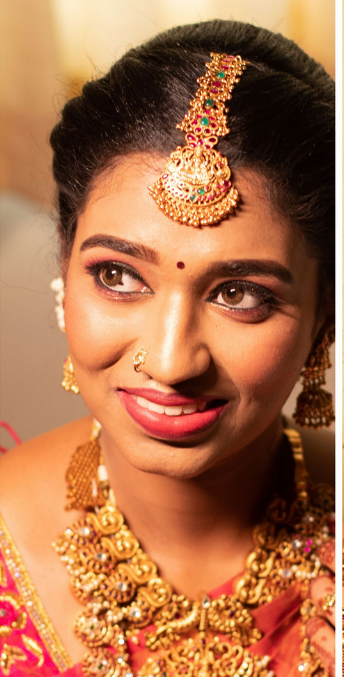
Growing up, Deepavali was easily my favourite festival of the year. And my excitement never waited until Deepavali day. It would start almost a month earlier!
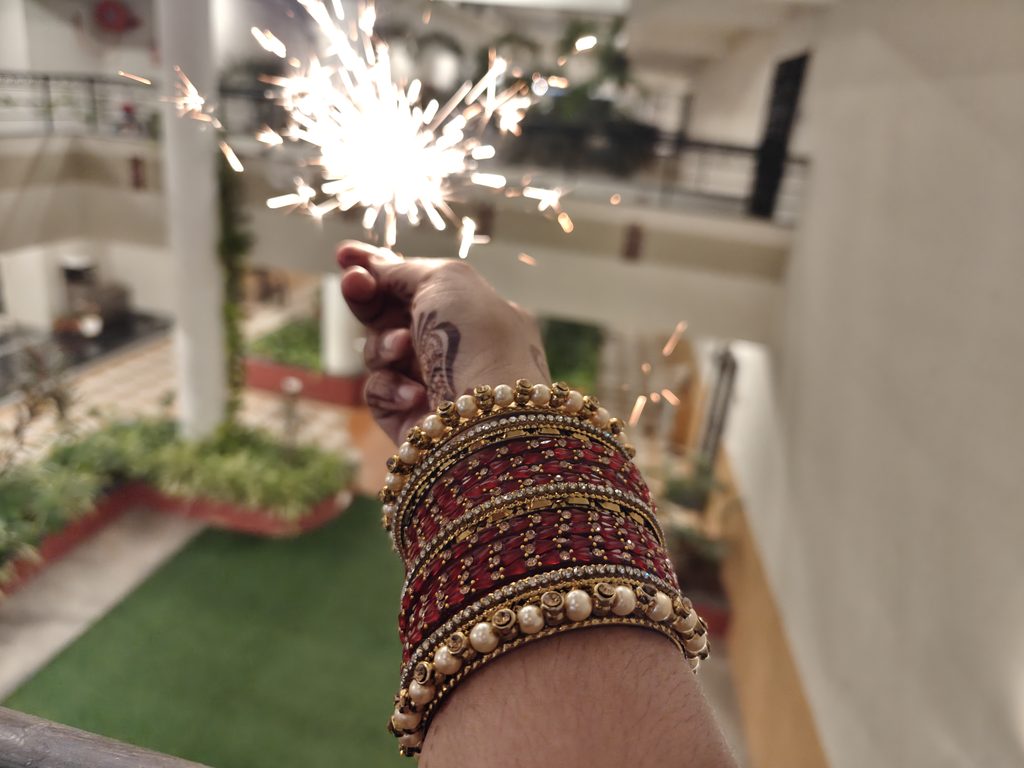
My brother and I were so impatient that we would start bursting crackers at least two weeks before the festival. Waiting until the actual day? That was asking too much of us!
Even today, Deepavali brings back some of my happiest childhood memories.
Diwali in Tamil Nadu is celebrated a little differently from how it is in many other parts of India. Our celebrations usually begin before sunrise, with a traditional oil bath, new clothes, prayers, plenty of homemade food, and, for many families, firecrackers.
Every family has its own way of celebrating, of course. But here are some of the traditions we grew up with, along with a few memories from my own home.
Why Is Deepavali Celebrated in Tamil Nadu?
Deepavali, also known as Diwali, is one of the most widely celebrated Hindu festivals in India.
In Tamil Nadu, the festival is closely associated with the story of Narakasura.
According to Hindu tradition, Narakasura was a powerful demon king who caused suffering to people. Lord Krishna defeated him, with Satyabhama playing an important role in several versions of the story.
The occasion is remembered as Naraka Chaturdashi and is associated with the victory of good over evil.
In many parts of North India, Diwali is also associated with Lord Rama’s return to Ayodhya after his exile. Lakshmi Puja is another important part of the festival in several regions.
Although the stories and customs differ, Diwali is celebrated by families across India in their own ways.
Diwali Rituals in Tamil Nadu: Deepavali Begins Before Sunrise
One thing that makes Deepavali in Tamil Nadu different is how early the celebrations begin.
In many Tamil households, the day starts around 3 or 4 AM, sometimes even before the neighbours are awake.
In our house, my mother would wake up at 3 AM to prepare food for the prayers.
And what was I doing at that time? Sleeping peacefully, of course!
As children, we never really thought about how much work went into making the day special. We simply woke up knowing everything would be ready.
The kitchen would already be busy, water would be heated for our baths, and our new clothes would be waiting.
Unlike the evening-focused Diwali celebrations common in several other parts of India, Deepavali morning is particularly important in Tamil Nadu. Many families begin with an oil bath, followed by new clothes, prayers, and a festive breakfast.
The exact routine varies between households, but the early start is one of the most familiar Deepavali traditions in Tamil Nadu.
Ganga Snanam: The Traditional Deepavali Oil Bath
If there is one Deepavali tradition I remember very clearly, it is the oil bath.
In Tamil Nadu, this traditional bath is called Ganga Snanam.
In many families, elders apply sesame oil, known as nallennai in Tamil, to the heads and bodies of family members before bathing.
In our house, my father was in charge of this.
He would pour what felt like half a litre of oil over my brother’s head and mine, then give us a proper massage. Half a litre might be an exaggeration, but honestly, it never felt like one!
And there was no escaping that oil bath. We had to wash our hair properly before we could get into our new clothes.
Why Is It Called Ganga Snanam?
According to traditional belief, bathing on Diwali in Tamil Nadu morning is considered spiritually significant and is associated with the sacred River Ganga.
The bath is seen by many families as a way to begin the festival with cleanliness and an auspicious start.
Some households traditionally use shikakai or herbal bathing powders to wash away the oil.
There is even a familiar Deepavali greeting in Tamil Nadu:
“Ganga Snanam Aacha?”
It means, “Have you finished your Ganga Snanam?”
If you have Tamil relatives, there is a good chance you have heard this question on Deepavali morning.
Wearing New Clothes
After the oil bath comes one of the most exciting parts of Deepavali — wearing new clothes.
For many Tamil families, buying new clothes is an important part of the celebration.
Children get colourful outfits, women often choose sarees or salwar suits, and men may wear shirts, trousers, or traditional veshtis.
In our family, as in many Tamil households, we have a little tradition before wearing our new clothes. We apply a touch of turmeric (manjal) to them and place them in front of God during our morning prayers. Only after the prayers do we put them on.
When I was little, all I cared about was putting on my new Deepavali dress and running outside to burst crackers.
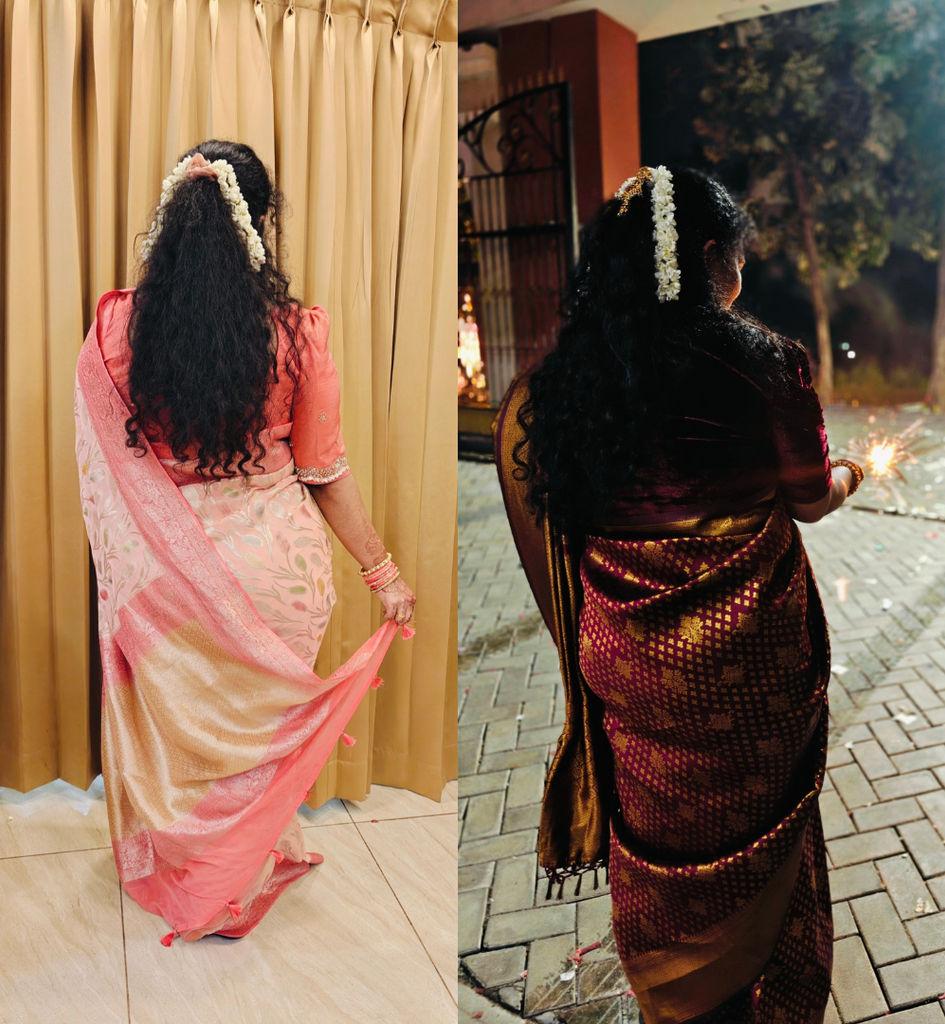
For years, my Deepavali outfits were all about Anarkalis, salwar suits, and maxi dresses. But this year, I chose a saree!
And somewhere along the way, I’ve started loving sarees, fresh jasmine flowers, and this time, I even applied mehendi to my hands.
My husband couldn’t believe it. Honestly, neither could I!
I think I’m finally becoming a grown-up!
It’s funny how our interests change. The little girl who couldn’t wait to get outside with her crackers is now excited about wearing a saree and putting malligai poo in her hair.
Of course, new clothes aren’t necessary to celebrate Deepavali, but for many families, they remain a much-loved tradition.
Prayers and Offerings to God
After the oil bath and new clothes, many Tamil families offer prayers at home.
The customs vary depending on family traditions and the deities worshipped.
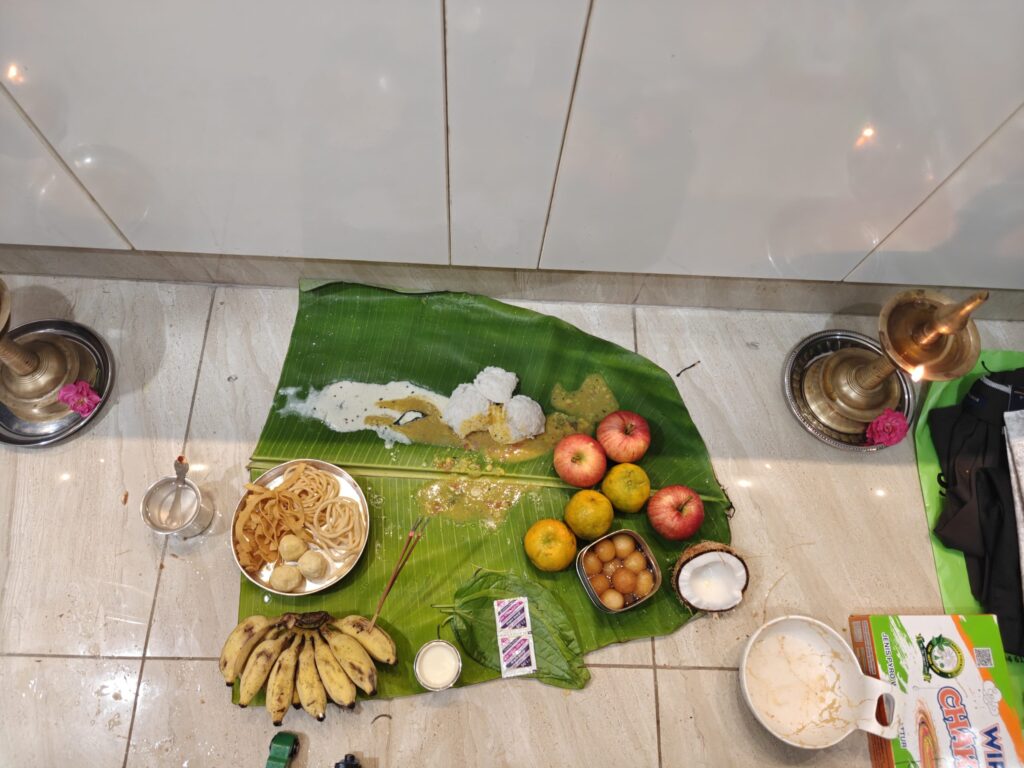
We light lamps, offer flowers, and prepare special dishes as naivedyam (food offered to God). Traditionally, we place the food in front of God during our prayers before sharing it with everyone.
This year, I made vadai and suzhiyam for the first time, especially for the prayers. And guess what? I completely forgot to place them in front of God! All that effort, and I forgot the most important part. Oops!
Some families also visit nearby temples during the day. Since we live in Trichy, Thanjavur is quite close to us. This year, we’re planning to visit the Thanjavur Big Temple. It feels like a lovely way to spend part of our Deepavali together.
There is no single prayer routine followed by every Tamil household. Each family has its own customs, often passed down from one generation to the next.
Deepavali Breakfast: The Best Reward for Waking Up Early
After the oil bath, prayers, and morning celebrations, it is finally time to eat.
And in our house, Deepavali breakfast was something worth waiting for.
My mother would prepare hot idlis, sambar, chutney, vadai, and suzhiyam.
There was something wonderful about sitting down together for a proper homemade breakfast after all the morning excitement.
And once we finished eating, we had a very important Deepavali tradition to follow.
Watching television!
There would always be special Deepavali programs, comedy shows, and movies.
We would settle down in front of the TV and watch whatever was on.
Deepavali Palagaram: The Boxes That Never Seemed to Empty
If crackers were the highlight of Deepavali for us as children, homemade sweets and snacks were a very close second.
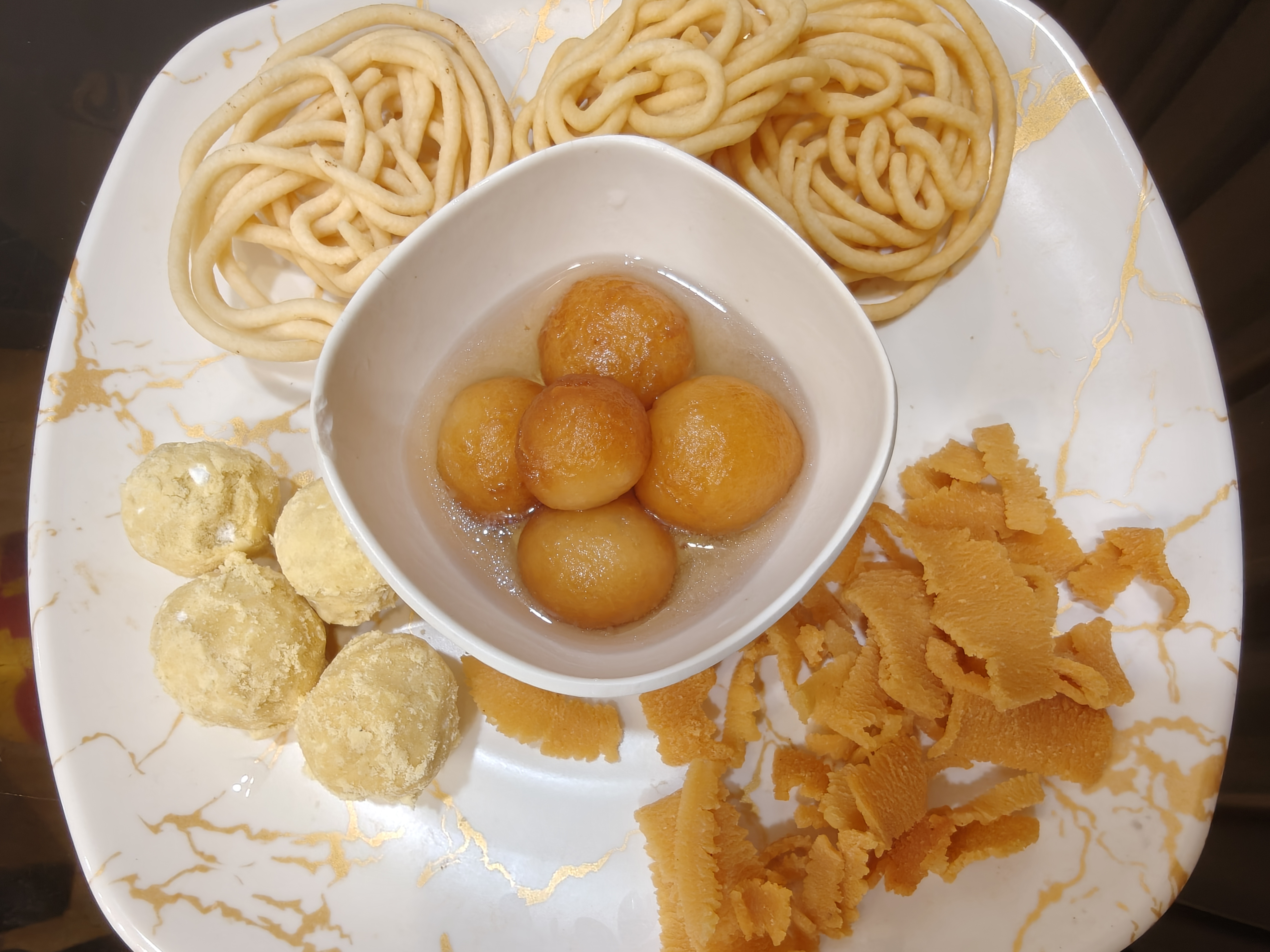
At our house, most of the Deepavali palagarams were made at home. My mother would prepare murukku, ola pakoda, gulab jamun, pasi paruppu urundai, rava urundai, adhirasam, and madakku.
And she never made just a little!
There would be boxes and boxes of snacks. We didn’t have to think about evening snacks for weeks, and dessert was sorted for almost a month.
The crackers weren’t the only things going off nonstop during Deepavali. Our mouths were just as busy, munching on something or the other all day!
And everything tasted so good because it was made by my mother. There’s something about Amma’s kaippakkuvam — that special touch in her cooking — that I don’t think anyone can quite recreate for me.
This year, I made ola pakoda and gulab jamun myself. The rest? My mother sent them over in a parcel!
Some things never change, thankfully.
Living away from family means we can’t always celebrate Deepavali together. Work and distance sometimes get in the way, and I do miss those days when everyone was under the same roof.
But opening a box of sweets made by my mother brings a little bit of home back to me.
Traditional Deepavali Sweets and Snacks in Tamil Nadu
Every family has its own Deepavali favourites, but these are some of the snacks commonly prepared in Tamil households.
- Murukku: A crunchy, spiral-shaped savoury snack made with rice flour.
- Ola Pakoda: A crisp, ribbon-shaped savoury snack made from seasoned flour dough.
- Adhirasam: A traditional sweet made with rice flour and jaggery.
- Pasi Paruppu Urundai: Sweet balls made with roasted moong dal, sugar or jaggery, and ghee.
- Rava Urundai: Sweet balls made with semolina, sugar, and ghee.
- Gulab Jamun: Soft, syrup-soaked sweets that are popular during festivals.
- Madakku: A traditional folded snack or sweet, with recipes that vary between families and regions.
Whether they are homemade or bought from a shop, sharing sweets and savouries with neighbors is one of the most familiar parts of Deepavali celebrations in Tamil Nadu.
Deepavali Lunch: A Non-Vegetarian Feast
I almost forgot to tell you about our Deepavali lunch!
After a morning of celebrations, a big breakfast, and plenty of snacks in between, you might think we would be too full for lunch.
Not in our house!
For us, Deepavali afternoon meant a proper non-vegetarian feast.
A mutton gravy, chicken 65, and a satisfying lunch with the family. And of course, no Deepavali lunch was complete without dessert. I would happily finish mine with four gulab jamuns.
Now that’s my kind of Deepavali lunch!
Only after all that could the afternoon rest officially begin.
Deepavali food traditions vary across Tamil Nadu. Some families prepare vegetarian feasts, while others enjoy chicken, mutton, or other special dishes.
There is no single menu that every household follows. But in our family, a delicious non-vegetarian lunch has always been part of the celebration.
Deepavali Legiyam: A Traditional Herbal Preparation
Deepavali legiyam, also known as Deepavali marundhu, is a traditional preparation eaten in some Tamil households during the festival.
It is commonly made using ingredients such as ginger, pepper, cumin, jaggery, and ghee.
The exact ingredients and preparation methods vary between families.
Traditionally, a small portion is eaten on Deepavali morning because it is believed to support digestion after enjoying rich festive foods.
However, these are traditional beliefs rather than medically established benefits.
Not every family prepares Deepavali legiyam, but it remains a familiar custom in many Tamil homes.
Firecrackers and Our Childhood Competitions
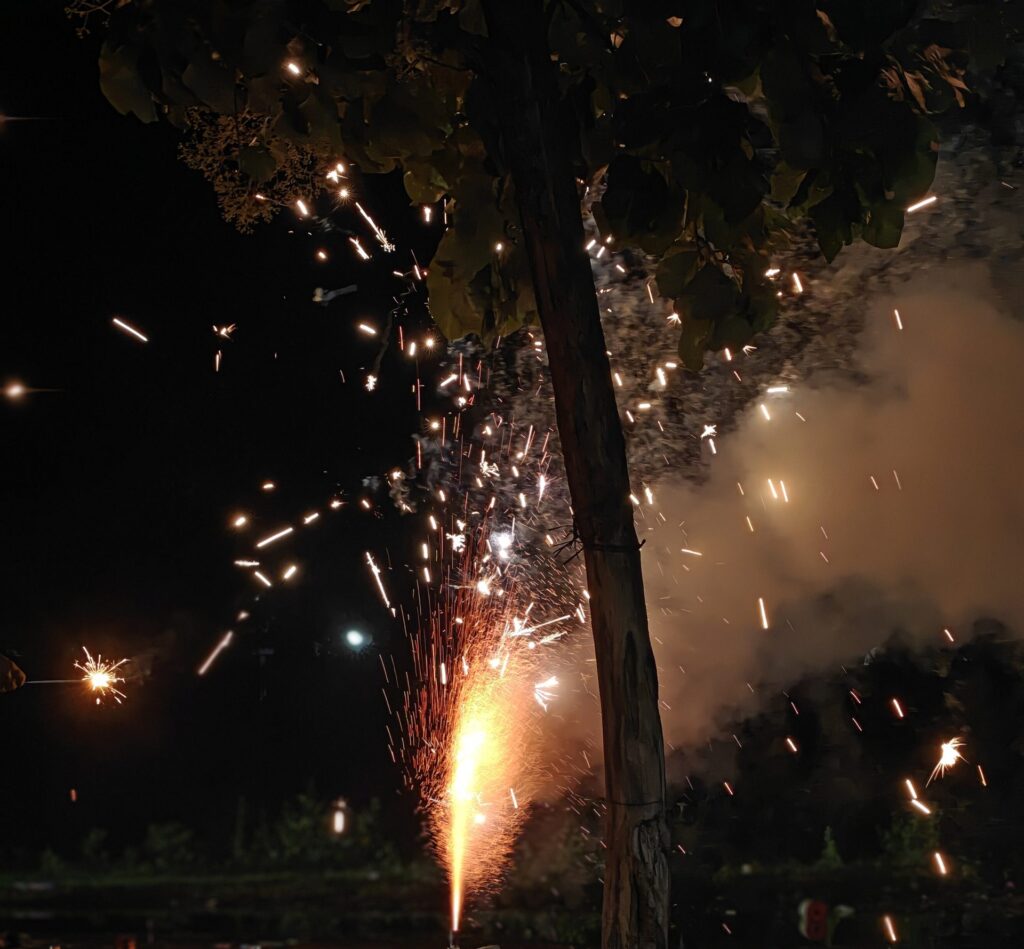
Firecrackers have traditionally been a familiar part of Deepavali in Tamil Nadu.
In many neighbourhoods, the sound of crackers begins early in the morning.
Popular varieties include sparklers, flower pots, ground spinners, and strings of firecrackers.
In our house, we would burst a sara vedi together as a family after our morning prayers.
And the celebrations didn’t end there.
By evening, my brother and I would be back outside with our crackers.
But the funniest part was the little competition we had with our friends.
We would compare the piles of cracker papers outside our houses to see who had burst the most crackers.
Whose house had the biggest pile?
That was the question!
There was no prize, no trophy, and absolutely no reason to take it so seriously. But we did!
Looking back, it was such a silly little competition, but it made Deepavali even more fun.
Things have changed a little over the years. We used to burst so many crackers as children, but these days, we’ve cut down quite a lot.
Many families are also choosing quieter celebrations because of concerns about pollution, noise, and safety.
We still enjoy the festive atmosphere, just with fewer crackers than before. And honestly, Deepavali is just as special.
For those who choose to burst crackers, it’s important to follow local restrictions and take proper safety precautions, especially around children.
Thalai Deepavali: The First Deepavali After Marriage
In Tamil Nadu, the first Deepavali celebrated by a couple after marriage is traditionally known as Thalai Deepavali.
It is a special occasion in many Tamil families.
Traditionally, the newly married couple may visit the bride’s parental home, where they are welcomed with new clothes, gifts, sweets, and a festive meal.
The customs vary between families, but Thalai Deepavali is often a memorable celebration for newly married couples.
Are Deepavali and Karthigai Deepam the Same?
No. Deepavali and Karthigai Deepam are two separate Hindu festivals.
Deepavali is generally celebrated during the Tamil month of Aippasi and is associated with Naraka Chaturdashi and the new-moon period.
Karthigai Deepam takes place during the Tamil month of Karthigai, usually in November or December.
It is especially associated with lighting rows of oil lamps.
The festival is particularly famous at Tiruvannamalai, where the Maha Deepam is lit on the hill.
Frequently Asked Questions
Why is Diwali celebrated early in the morning in Tamil Nadu?
Deepavali in Tamil Nadu is closely associated with Naraka Chaturdashi. Many families begin their celebrations before sunrise with an oil bath, prayers, new clothes, and festive food.
What is Ganga Snanam?
Ganga Snanam is the traditional Deepavali morning bath. In many Tamil households, sesame oil is applied before bathing, and the custom is considered auspicious.
What food is prepared for Deepavali in Tamil Nadu?
Popular foods include adhirasam, murukku, suzhiyam, mixture, laddu, and Mysore pak. Many families also prepare special breakfast and lunch dishes.
What is Thalai Deepavali?
Thalai Deepavali is the first Deepavali celebrated by a couple after marriage. In many Tamil families, it includes visiting the bride’s parental home, receiving gifts, and enjoying a special meal.
Do all Tamil families burst crackers during Deepavali?
No. Although fireworks have traditionally been part of the festival, some families prefer quieter celebrations without crackers.
This Year’s Deepavali: A New Little Memory
This year, Deepavali feels a little more exciting because my little boy is almost three.
He’s at that age where everything is interesting, and I can’t wait to see his reactions to all the celebrations.
This will be his first time experiencing the excitement of crackers. We’ll be keeping him at a safe distance while the adults handle the fireworks, but I already know I’m going to be more excited than he is!
I want him to enjoy the little things I loved growing up — getting dressed in new clothes, eating all the special food, and spending the day with family.
It’s funny how quickly life changes.
I was once the little girl whose parents made Deepavali so special. Now I’m the mother trying to do the same for my son.
And who knows? Maybe one day he’ll have his own funny Deepavali stories to tell.