
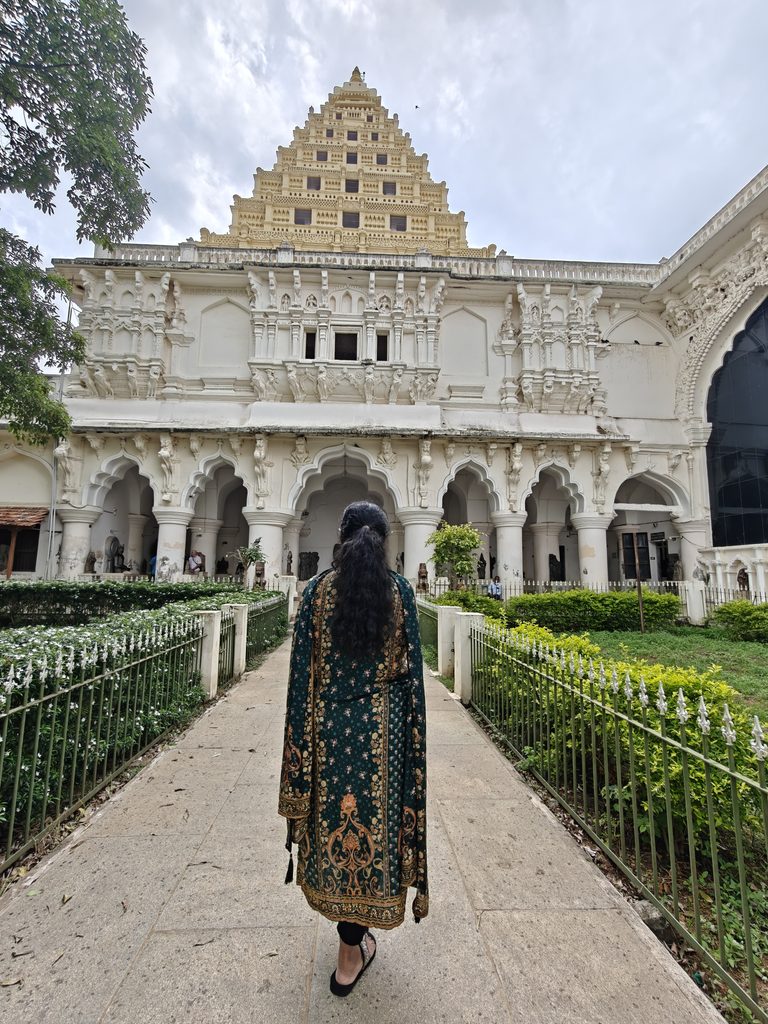
Just a short distance from the famous Brihadeeswarar Temple stands Thanjavur Palace, which tells a completely different chapter of the city’s history, once home to the Nayak and Maratha rulers of Thanjavur.
Don’t expect a single grand building filled with royal bedrooms and furniture. Thanjavur Palace is a collection of old royal halls, courtyards, museums, towers, and a historic library. Some buildings have been restored, while others still show the effects of time.
There is so much to see here, from Chola-period bronze sculptures and colourful royal paintings to a tall arsenal tower and an underground passage surrounded by intriguing stories.
We visited Thanjavur Palace on a Friday in October, arriving around 11 AM. The weather was unusually pleasant that day, making it comfortable to explore the place.
In this guide, we’ll take you through the main things to see inside Thanjavur Palace, along with a little history, entry fees, opening hours, how to explore the complex, and tips for planning your visit.
Thanjavur Palace at a Glance
LOCATION | Thanjavur, Tamil Nadu
ALSO KNOWN AS | Thanjavur Maratha Palace, Aranmanai
BUILT BY | Nayak rulers in the 16th century, later expanded by the Marathas
DON’T MISS | Durbar Halls, Art Gallery, Arsenal Tower, Royal Museum, and Saraswathi Mahal Library
TIME NEEDED | 2–3 hours
ENTRY FEE | ₹50 for Indian adults, ₹100 for foreign visitors (October 2026)
CHILDREN | Free for ages 6 and below during our visit
BEST TIME | November to February
About Thanjavur Palace
I always thought Thanjavur Palace was built by the Cholas. After all, Thanjavur was once their capital, and Raja Raja Chola I built the magnificent Brihadeeswarar Temple here.
But when I started learning more about the palace, I was surprised to know that it was built centuries later, during the Nayak period. The Big Temple was completed around 1010 CE, while the present palace complex began taking shape in the 16th century, roughly 500 years later.
Spread across approximately 110 acres, Thanjavur Palace is located in the heart of Thanjavur.
Also known as Thanjavur Maratha Palace or Aranmanai, the palace was later expanded by the Maratha rulers, whose descendants remain associated with parts of the complex today.
A Little History of Thanjavur Palace
Thanjavur Palace dates back to the 16th century, when the Nayaks ruled Thanjavur under the Vijayanagara Empire. Sevappa Nayak established the Thanjavur Nayak dynasty in the 1530s, and the palace was developed by the Nayak rulers.
In 1673, the Madurai Nayaks invaded Thanjavur following a dispute over a royal marriage proposal. Vijayaraghava Nayak, the last Nayak ruler, was killed during the conflict.
Around 1674, Venkoji (also known as Ekoji), the half-brother of Chhatrapati Shivaji, established Maratha rule in Thanjavur. The Marathas expanded the palace and ruled the region for nearly two centuries.
One of the most notable Maratha rulers was Serfoji II, who ruled from 1798 to 1832. He expanded Saraswathi Mahal Library and added thousands of books and manuscripts to its collection.
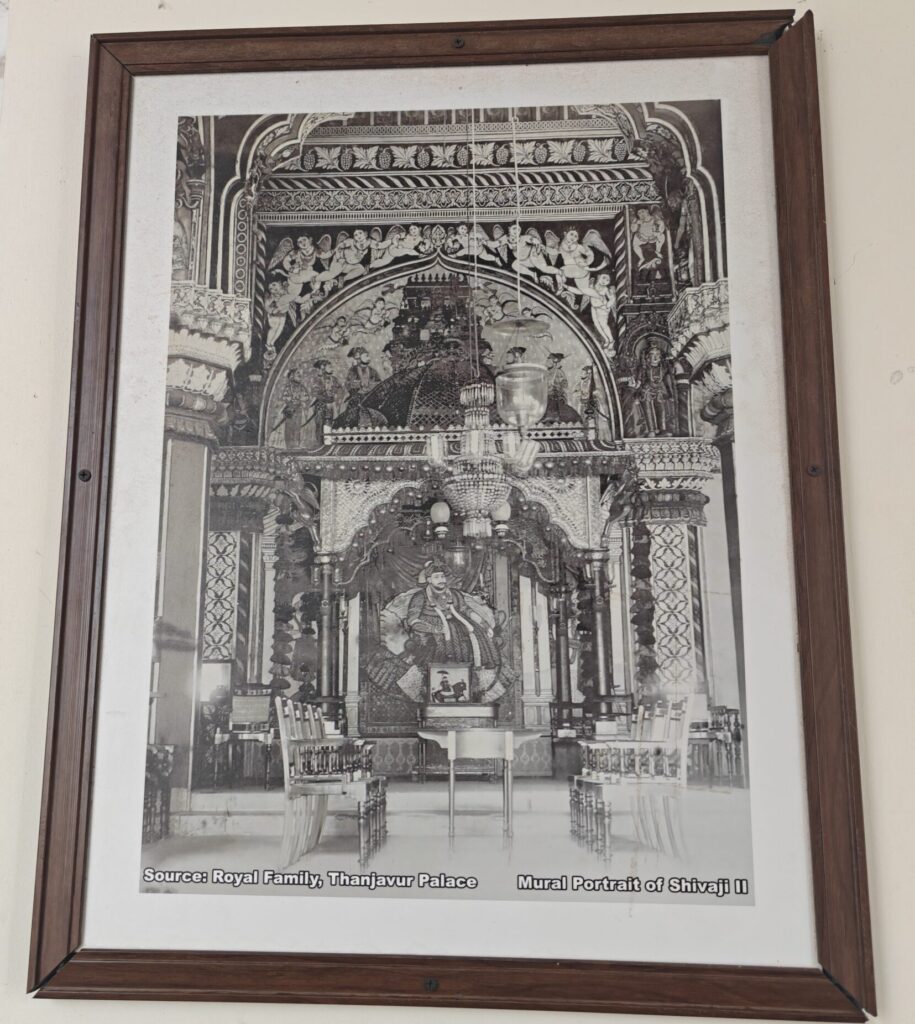
In 1799, the British took control of much of Thanjavur’s administration. The kingdom was annexed in 1855, following the death of Shivaji II, the last reigning Maratha king.
The change from Nayak to Maratha rule has a fascinating history involving a royal marriage dispute, battles, and political intrigue.
Map of Thanjavur Palace & Brihadeeswarar Temple
Thanjavur Palace and Brihadeeswarar Temple are located close to each other in the heart of Thanjavur. Use the map below to find both locations and plan your visit.
How to Use This Map: Click the menu icon in the top left corner to see all the places marked on the map. You can turn individual layers on or off to focus on the area or route you want to explore. Click any marker for more information about that stop.
For a larger view, click the icon in the top right corner. To save the map for your trip, sign in to your Google account and click the star beside the map’s title. This makes it easier to find again when you need it.
8 Best Things to See Inside Thanjavur Palace
Thanjavur Palace is not a single museum where you follow one continuous route.
The attractions are spread across different buildings and courtyards. Some are close together, while others require you to walk to explore them.
Saraswathi Mahal Library is a useful landmark for understanding the layout.
The Art Gallery, Nayak Durbar Hall, Arsenal Tower, Bell Tower, and Sangeetha Mahal are associated with one part of the complex. The Royal Museum and Maratha Durbar Hall are found in another section.
Several sections are open to visitors as museums and galleries, while parts of the palace remain associated with the descendants of Thanjavur’s Maratha royal family.
Here are eight places worth exploring during your visit.
1. Saraswathi Mahal Library
Saraswathi Mahal Library is one of the oldest historic libraries in India, with a history stretching back around 400 years.
It was originally established during the Nayak period for the use of the royal family and was later expanded by the Maratha rulers, particularly King Serfoji II.
The library holds rare manuscripts, old books, paintings, maps, and historical documents in several languages, including Tamil, Sanskrit, Telugu, English, French, German, and Italian. It also reflects the rulers’ interest in science, education, and knowledge from different parts of the world.
For centuries, the collection was reserved for the royal family before being opened to the public around a hundred years ago.
2. Sangeetha Mahal
Sangeetha Mahal, also known as the Hall of Music, is located near Saraswathi Mahal Library.
Like the Cholas before them, the Nayak and Maratha rulers were great patrons of music, dance, and the performing arts. This hall was used for musical and cultural performances during the royal period.
One of its interesting features is its acoustic design, which allowed music and voices to carry through the hall without modern amplification.
Sangeetha Mahal is a reminder of Thanjavur’s long tradition of supporting music and dance, a legacy that continues today.
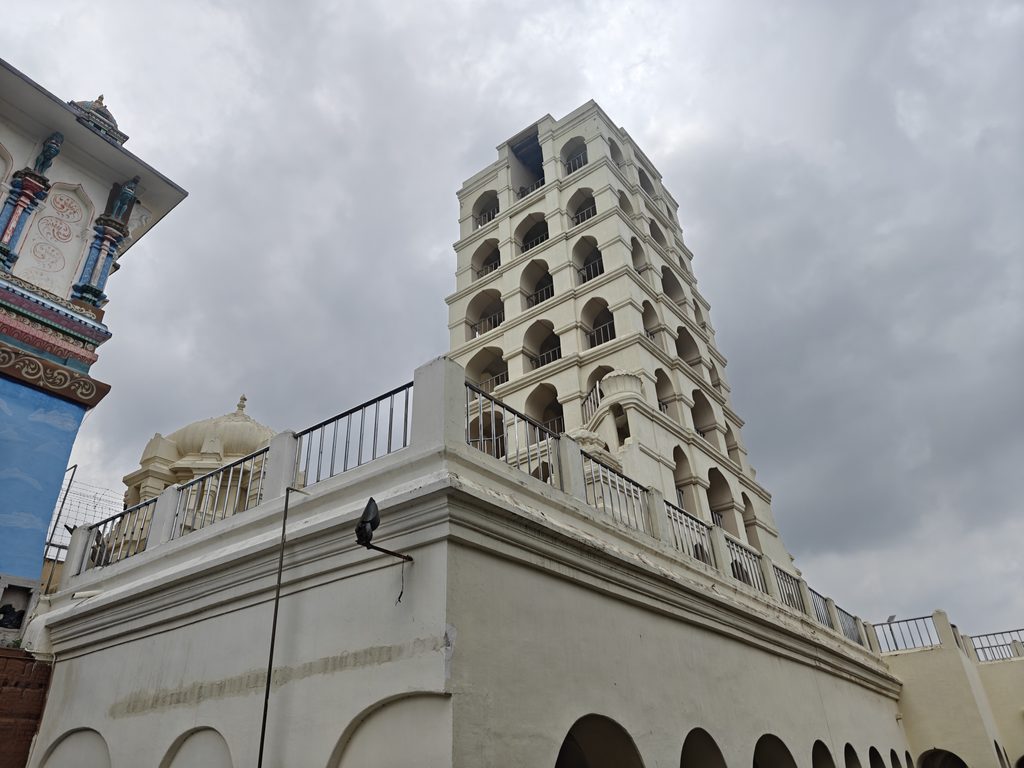
3. Bell Tower (Manikopuram)
The Bell Tower, also known as Manikopuram, is one of the prominent structures inside Thanjavur Palace. You’ll come across it near Sangeetha Mahal, before entering the Art Gallery.
The tower dates to the Nayak period and is known for its tall, distinctive architecture.
According to local stories, a large bell once hung at the top of the tower. It was reportedly rung every hour, and its sound was said to be heard across Thanjavur. The bell is no longer there.
Visitors cannot enter the tower, but you can admire its exterior from the palace grounds.
It’s a quick stop on the way to the Art Gallery, so take a moment to look up at the tower before continuing your visit.
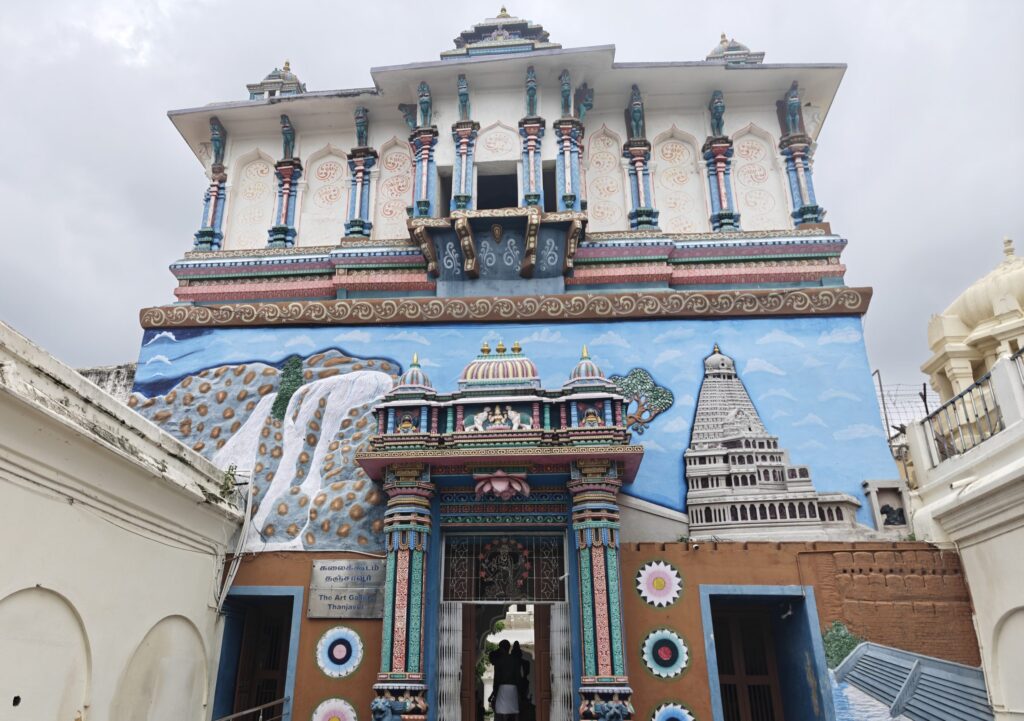
4. Thanjavur Palace Art Gallery
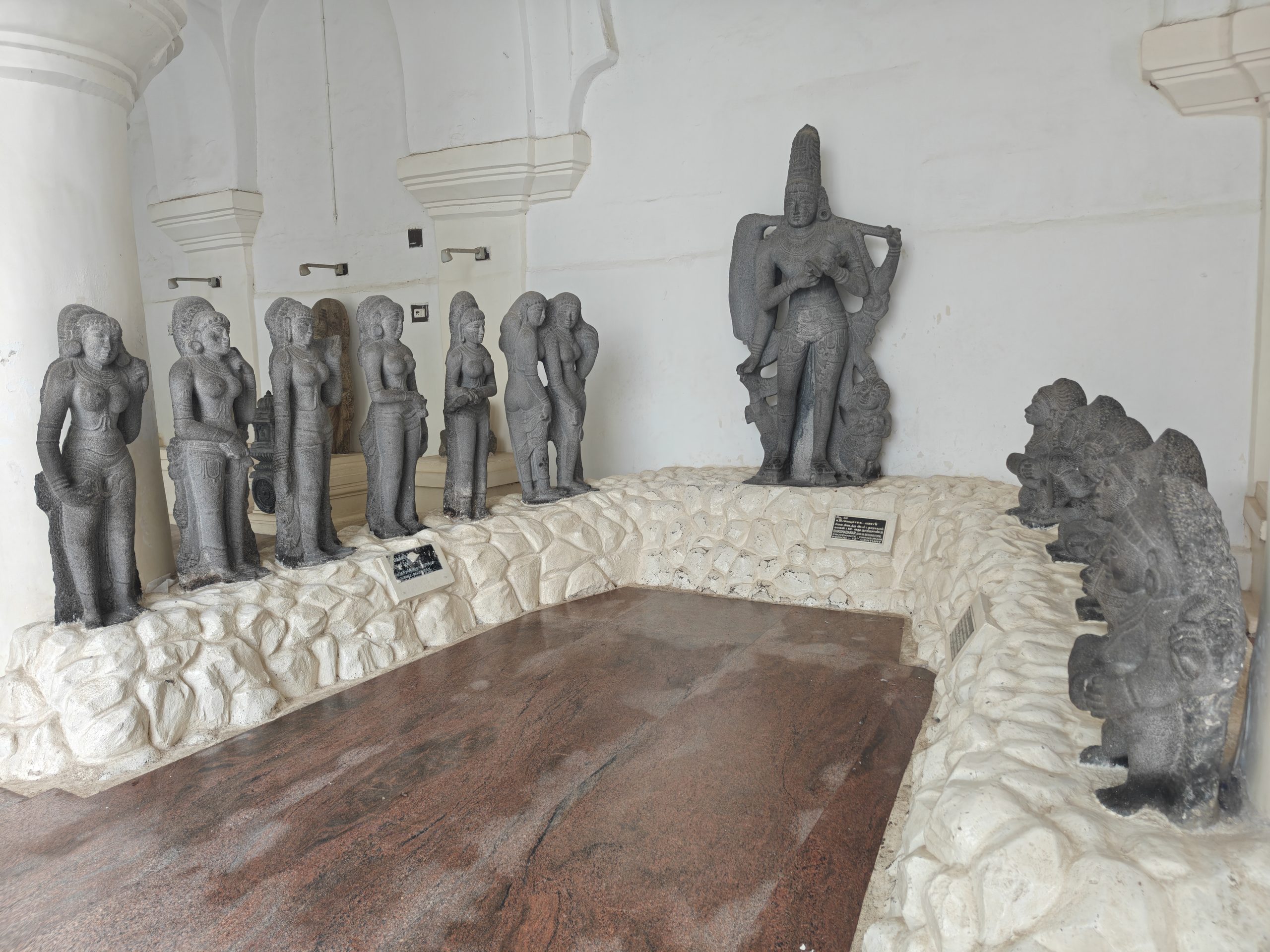
The Art Gallery was one of my favourite parts of Thanjavur Palace. I really enjoyed looking at the sculptures, and I was especially fascinated to see a sculpture identified as a Chola king and his wife as soon as I entered the gallery.
The gallery houses a collection of stone sculptures, many dating back to the Chola period. Although the palace itself was built centuries after the Cholas, several sculptures from their time are preserved here.
As you walk through the main gallery, you’ll see stone sculptures of Shiva, Vishnu, and other Hindu deities in different forms. Some are large and immediately catch your attention, while others have smaller details that are easy to miss.
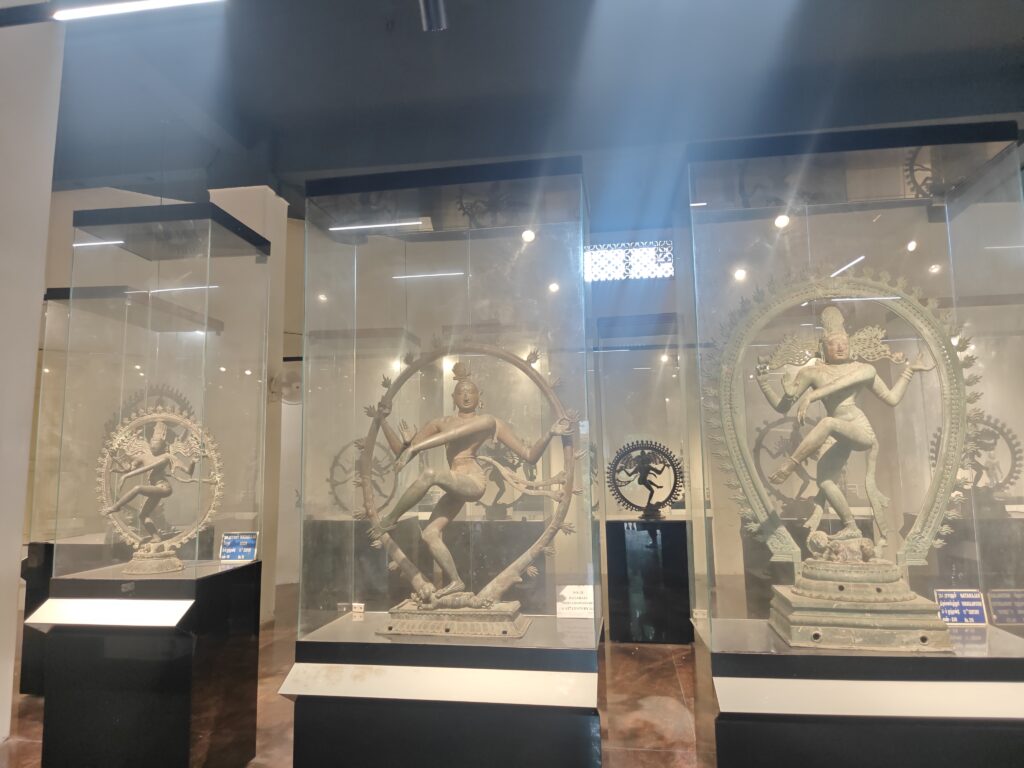
Inside the gallery, there is also a separate section called Nataraja Hall, where numerous bronze sculptures of Lord Nataraja, the dancing form of Shiva, are displayed.
The Cholas were known for their remarkable skill in bronze casting, and seeing so many Nataraja sculptures together makes this hall particularly interesting.
If you enjoy history and art, take your time exploring both the stone sculptures in the main gallery and the bronze statues in Nataraja Hall.
From here, continue towards the Nayak Durbar Hall, our next stop inside the palace.
5. Nayak Durbar Hall
The Nayak Durbar Hall is one of the most beautiful parts of Thanjavur Palace. What caught my attention was its high, beautifully decorated ceiling and the colourful paintings covering the walls.
The hall was built during the Nayak period and later modified by the Maratha rulers. Its roof has a distinctive wagon-shaped design, known as salakara.
At the centre of the hall is a raised granite platform with a white statue associated with King Serfoji II. Behind it is a colourful painting of Rama Pattabhishekam, depicting the coronation of Lord Rama.
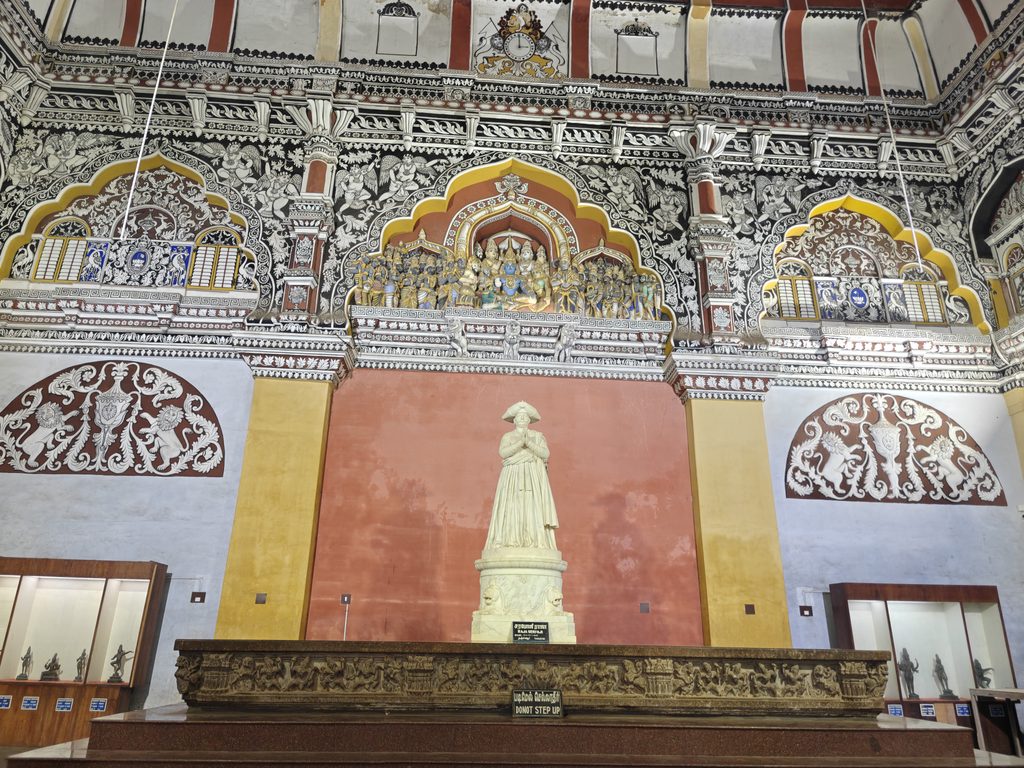
Interestingly, an old literary work called Raghunathabhyudayam describes a royal building named Sri Rama Soudham, with a granite platform, a golden canopy, and a painting of Rama’s coronation. These details are similar to what we see in the Nayak Durbar Hall today, although it has not been confirmed that they are the same building.
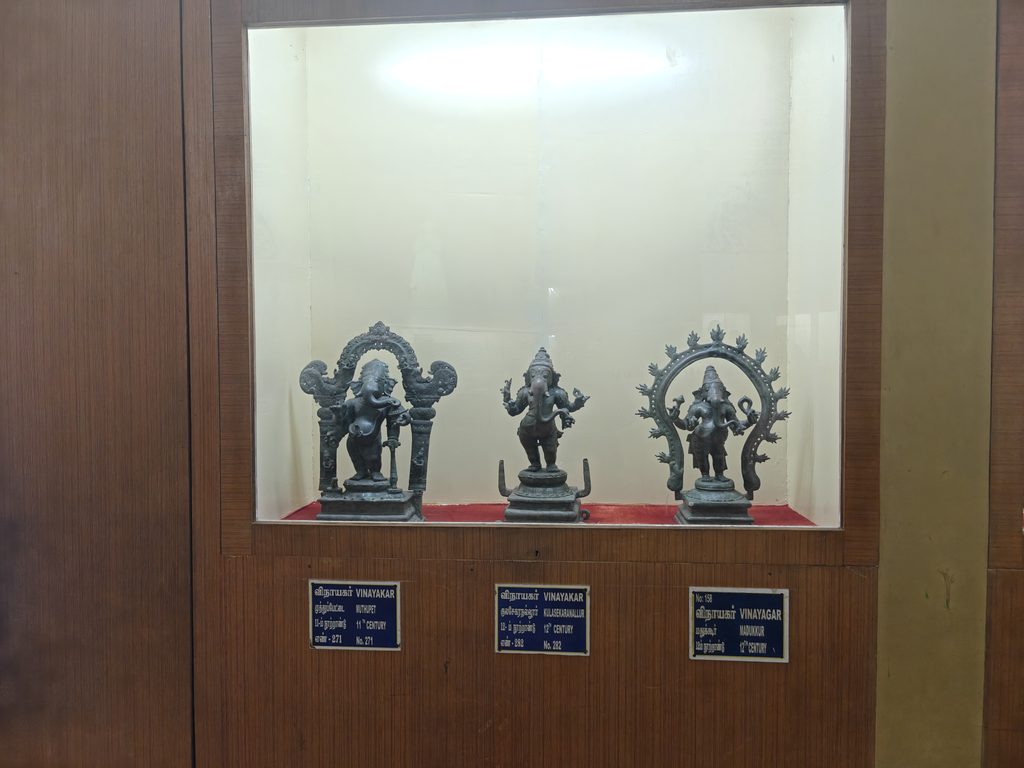
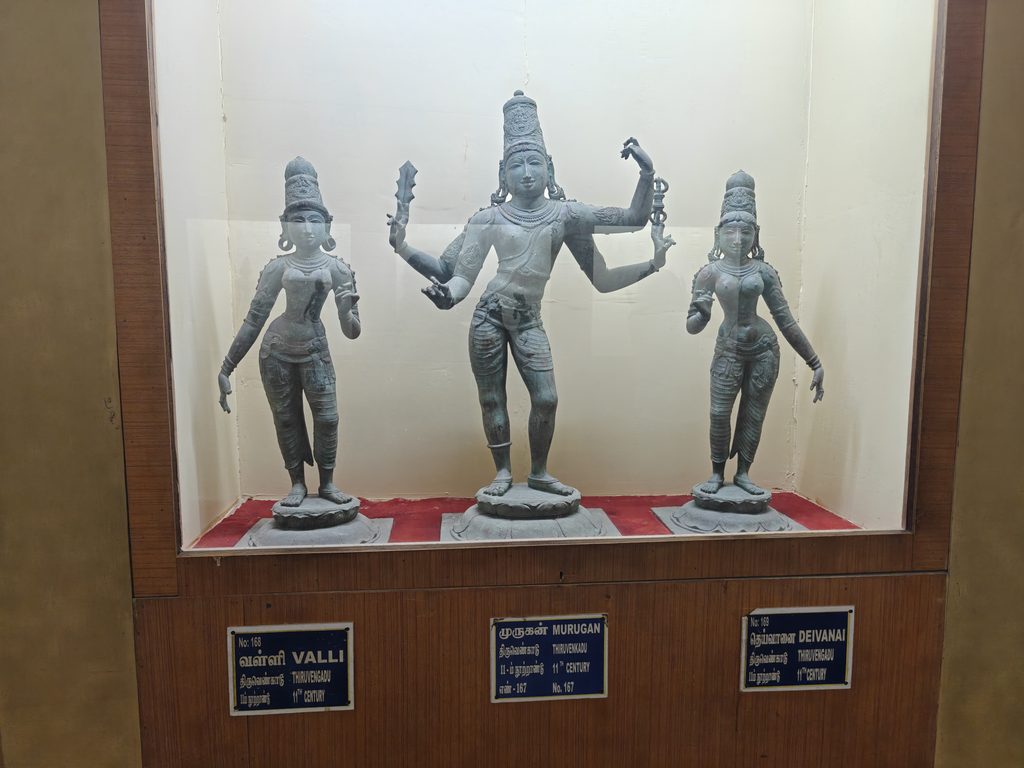
Beyond the paintings and architecture, there are glass display cases filled with bronze sculptures. I particularly noticed the different forms of Lord Vinayagar. There are also sculptures of Murugan with Valli and Deivanai, and Vishnu with Sridevi and Bhudevi.
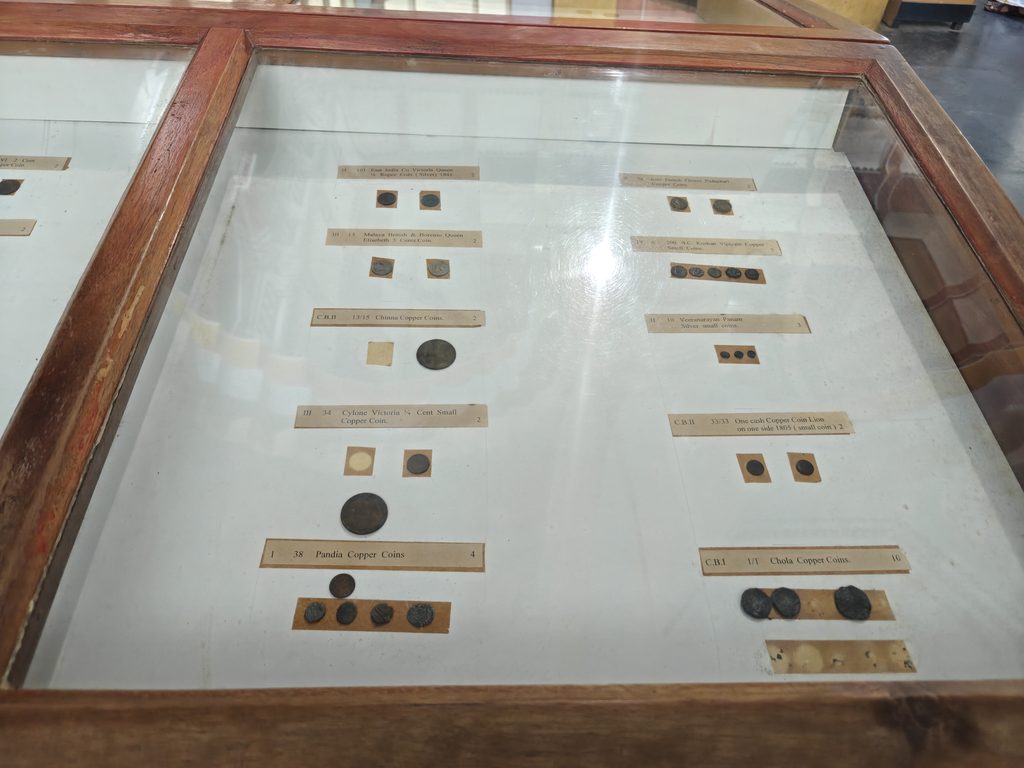
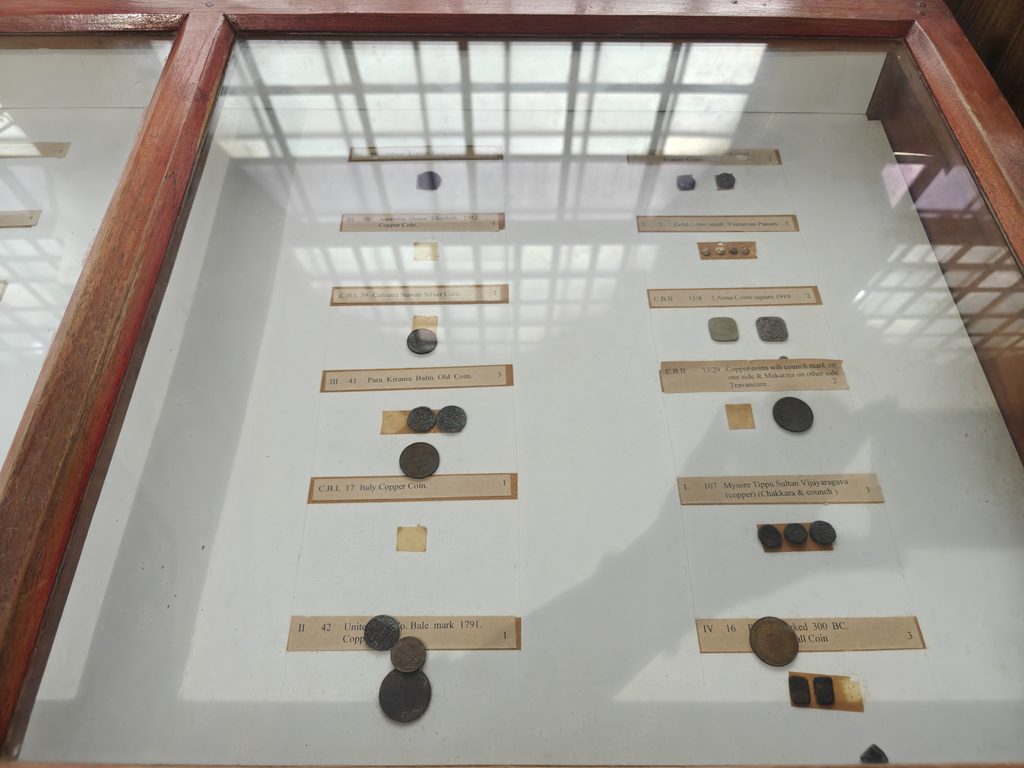
Another interesting collection is the old coins displayed in glass-covered cases. Among them are copper coins from the Chola and Pandya periods, with labels identifying the different collections.
6. Arsenal Tower (Ayudha Gopuram)
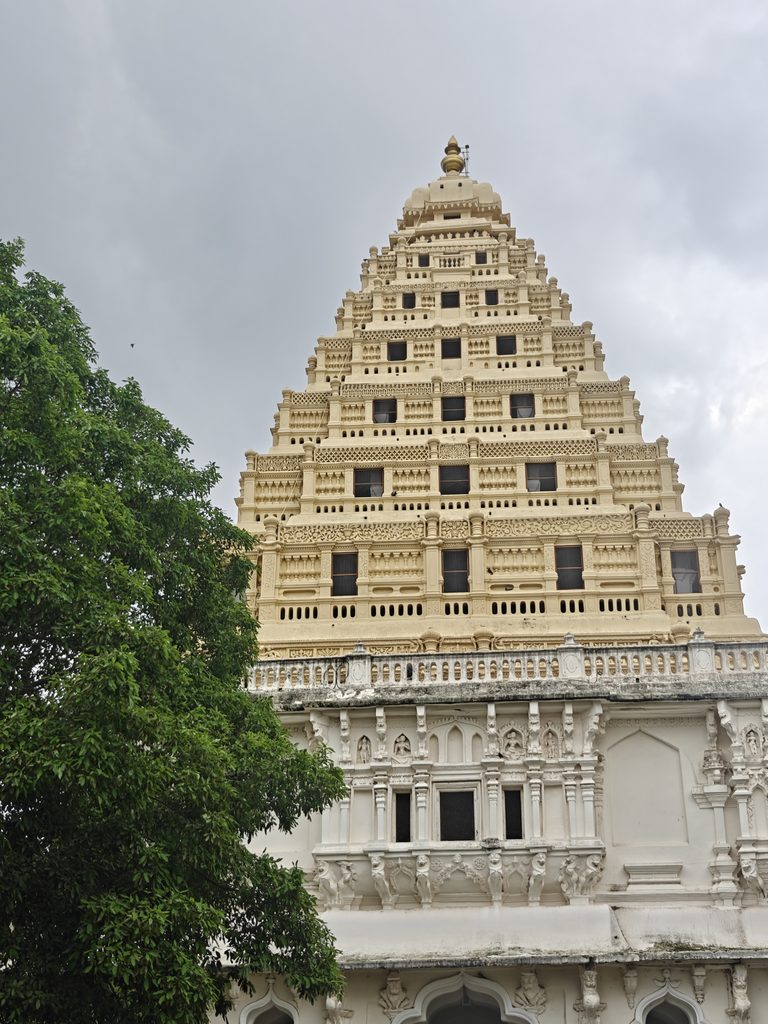
The Arsenal Tower (Ayudha Gopuram) is hard to miss when you’re exploring Thanjavur Palace. It’s much taller than the buildings around it, with a narrow top and a broad base.
The tower was built during the Nayak period and later used by the Marathas to store weapons and ammunition. It is also believed to have been used as a watchtower.
The tower is said to have ten levels, although only the lower sections are accessible to visitors. The staircases are narrow, so take care if you plan to climb.
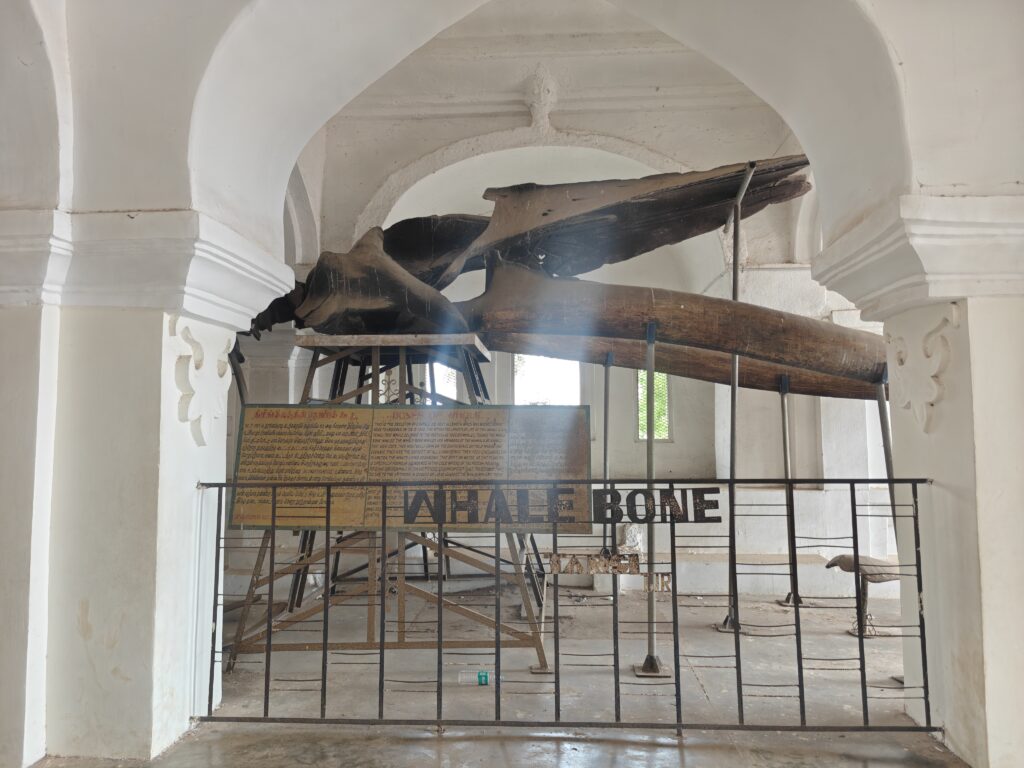
One of the most unexpected things we saw here was a huge whale bone displayed behind a railing. It was quite a surprise to find something like this inside a historic palace tower.
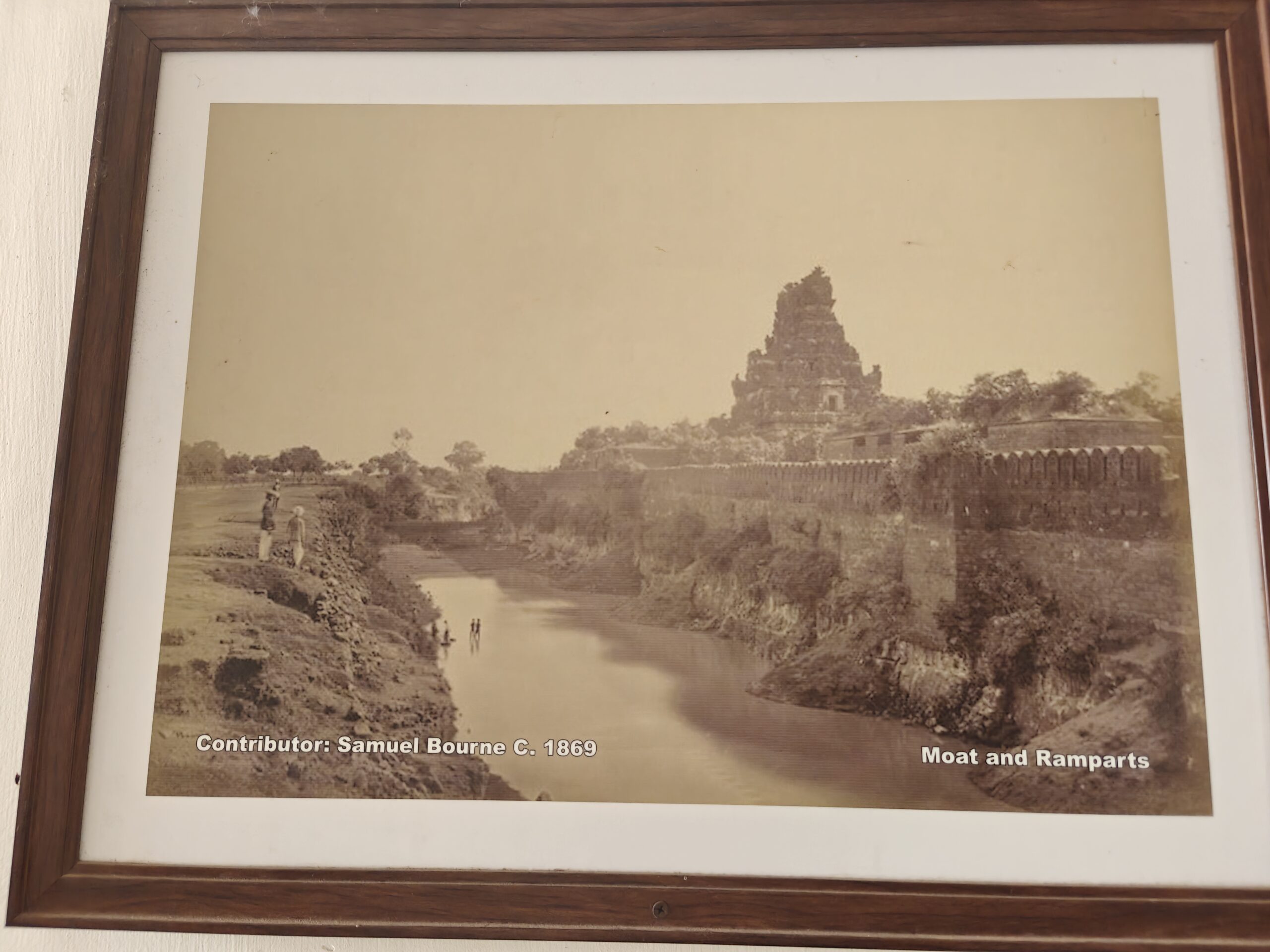
There are also old photographs of Thanjavur on display. One shows the town’s old bus stand around 1950, while another shows Brihadeeswarar Temple in 1869, photographed by Samuel Bourne. I particularly enjoyed seeing the old photograph of the Big Temple and how it looked more than 150 years ago.
7. Royal Museum and Underground Passage
The Royal Museum is located near Saraswathi Mahal Library, in another part of Thanjavur Palace.
Inside the museum, we saw clothing displayed as having been worn by King Serfoji II. It was particularly interesting to see something so personal belonging to a ruler who once lived in this part of the palace.
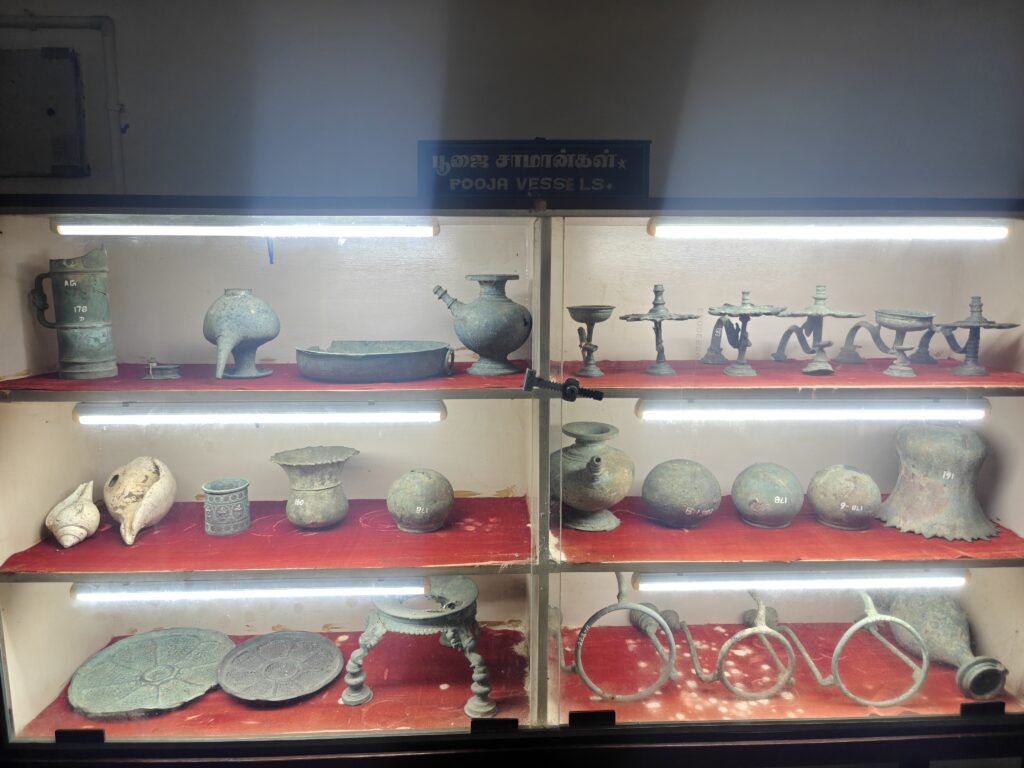
The museum also displays ceremonial objects, swords, daggers, old firearms, and cannonballs. You’ll also find traditional fly-whisks called venchamaram, which were used during royal ceremonies.
The Underground Passage
Another interesting feature here is the underground passage.
A staircase leads down to the underground passage, but visitors can explore only a limited section. The rest of the passage is closed to the public.
There are several stories about where it once led. One claims that the passage extended nearly six kilometres to Punnainallur Mariamman Temple, while another suggests that a branch connected it to Brihadeeswarar Temple.
Some stories even describe the passage as wide enough for two horse-drawn carriages to travel through.
Another underground passage is also associated with the Maratha Durbar Hall.
Even though much of its history remains a mystery, the underground passage is worth seeing while exploring the Royal Museum.
8. Maratha Durbar Hall
The Maratha Durbar Hall is one of the most beautifully decorated parts of Thanjavur Palace. Its colourful paintings and intricately carved pillars make it worth spending some extra time here.
A durbar was a royal court where kings met their ministers, military commanders, and other officials.
Before entering the hall, take a look around the courtyard. You’ll find old cannons, a Nandi sculpture, stone carvings, and several historical objects.
One unusual exhibit is an old milestone marked with the Tamil numeral eight, indicating a distance of eight miles to Thanjavur. You can also see a decorative lamp pillar featuring a yali, sculptures of the Sapta Kanniyar, and an inscription associated with the Maratha ruler Tuljaji.
Paintings of the Maratha Royal Court
One of the highlights is a painting depicting Shivaji II, the last reigning Maratha king of Thanjavur, alongside his Diwan (minister) and Dalavoy (military commander).
Another painting shows the king seated in his royal court, surrounded by ministers and officials. You can also see attendants holding ceremonial fly-whisks and figures identified as British representatives.
These paintings offer an interesting glimpse into the royal court during the later Maratha period.
Dashavatara Sculptures
The pillars feature carvings of the Dashavatara, the ten avatars of Lord Vishnu, including Matsya, Kurma, Varaha, Narasimha, and Vamana.
Take a closer look at the carvings, as some of the smaller details are easy to miss.
Wall Paintings and Sculptures
The hall also contains paintings depicting the weddings of Rama and Sita and Shiva and Parvati, along with scenes of Mount Kailash and Vaikuntha.
Above the pillars, you’ll find depictions of deities with their traditional mounts, including Vishnu on Garuda and Shiva on Nandi.
There are also paintings of reclining Vishnu, Murugan with Valli and Deivanai, and Krishna with Rukmini and Satyabhama.
With so much artwork covering the walls and pillars, it’s worth taking your time to explore this hall rather than rushing through it.
Thanjavur Palace Entry Fee
The entry fee for Thanjavur Palace was ₹50 for Indian adults and ₹100 for foreign visitors. Children aged 6 and below could enter for free. A separate ticket is required to visit Saraswathi Mahal Library.
Cameras, including DSLRs, are allowed inside the palace complex, although additional camera charges may apply. Photography may also be restricted in certain museums, galleries, and the library, so check the rules before taking pictures. Buy all the needed tickets at the ticket counter near the library. Otherwise, you may have to walk all the way back from the Art Gallery to purchase the library ticket.
Thanjavur Palace Timings
Thanjavur Palace has museums, halls, and galleries, and they don’t all follow the same opening hours.
These are previously reported opening hours and may have changed. Some attractions also close for lunch, so check the timings before your visit.
3 PM – 6 PM
1:30 PM – 5:30 PM
1:30 PM – 5:30 PM
How Much Time Do You Need at Thanjavur Palace?
I recommend spending about 2 to 3 hours at Thanjavur Palace to see the main attractions without rushing.
The palace is spread across several buildings and courtyards, so you’ll need some time to walk between them. The Art Gallery and the two Durbar Halls are worth spending a little longer in, especially if you enjoy looking at old sculptures and paintings.
If you’re interested in history, you could easily spend more than three hours here. We found ourselves stopping quite often to look at the exhibits, particularly the Chola sculptures and old photographs of Thanjavur.
If you’re short on time, you can still see some of the main attractions in around two hours, but you may have to skip a few sections.
Best Time to Visit Thanjavur Palace
The best time to visit Thanjavur Palace is from November to February; the weather is generally more comfortable for sightseeing.
Thanjavur gets hotter from March to August, making it tiring to explore the palace, especially during the afternoon.
We visited in late October, and the weather was pleasant because of the recent rains. Even so, we found some of the rooms inside the palace a little hot and stuffy.
If you’re visiting during the hotter months, try to arrive in the morning before it gets too hot. Carry drinking water, as you’ll be walking between several buildings and open courtyards.
How to Reach Thanjavur Palace
Thanjavur Palace is located in the center of Thanjavur, about 1–1.5 km from Brihadeeswarar Temple.
By Train: Thanjavur Junction is approximately 2 km from the palace. You can take an auto-rickshaw or taxi from the station.
By Bus: Thanjavur has regular bus connections from nearby cities, including Tiruchirappalli and Kumbakonam. Once you reach town, take an auto-rickshaw to the palace.
By Car: If you’re driving, search for Thanjavur Maratha Palace on Google Maps. Parking is available at the palace.
Parking at Brihadeeswarar Temple can be a little tricky, though, especially when it’s crowded.
Visiting Thanjavur Palace and Brihadeeswarar Temple on the Same Day
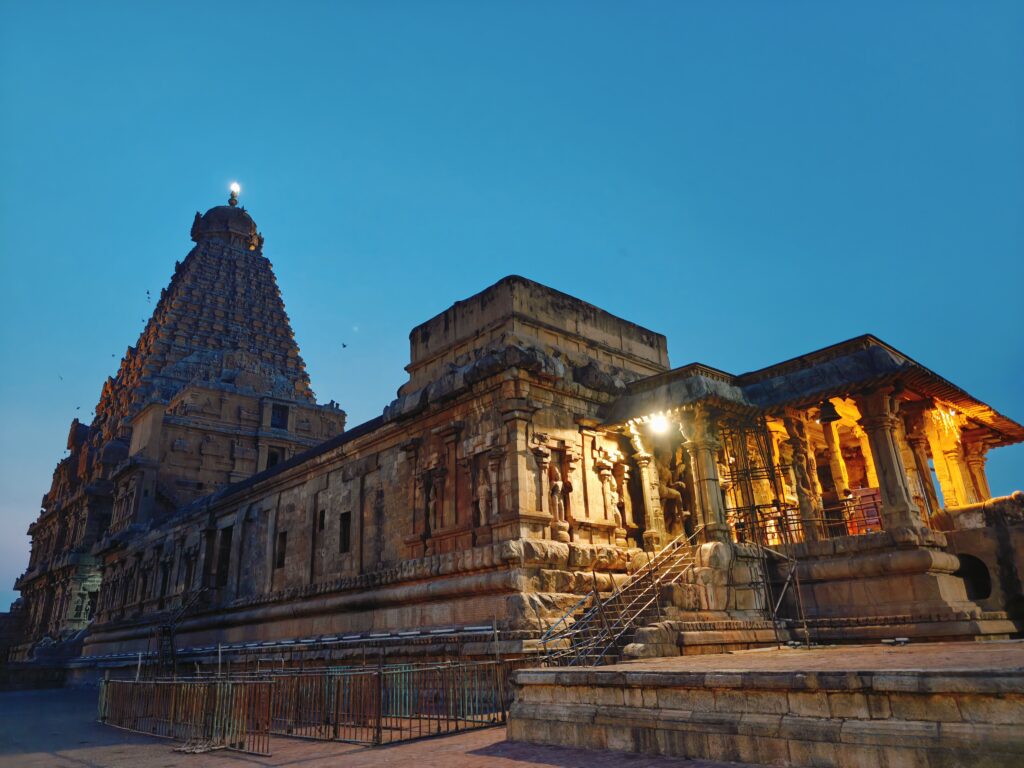
Thanjavur Palace and Brihadeeswarar Temple are close enough to visit on the same day.
They also offer two different sides of Thanjavur’s history. Brihadeeswarar Temple was built during the Chola period, while the palace was developed by the later Nayak and Maratha rulers.
I recommend visiting the palace first, since its museums, galleries, and library have different opening hours. You can then spend the rest of your day exploring Brihadeeswarar Temple.
If you have a full day in Thanjavur, there’s no need to rush through either place.
If you’re planning to visit both places, read our Thanjavur Big Temple Guide for its history, architecture, and practical tips for visiting.
Is Thanjavur Palace Worth Visiting?
I would say yes, especially if you enjoy history.
I enjoyed the Art Gallery the most, particularly the Chola sculptures. The two Durbar Halls were also worth exploring, with their colourful paintings and detailed architecture.
Some parts of the palace are well maintained, while others could use more attention. Even so, I think it’s worth setting aside a few hours to explore this side of Thanjavur’s history.
Frequently Asked Questions
Who built Thanjavur Palace?
Thanjavur Palace was originally built during the Nayak period in the 16th century. The Maratha rulers later expanded and renovated parts of the palace.
Was Thanjavur Palace built by the Cholas?
No. The palace was built centuries after the Chola period. However, you can see Chola-era stone sculptures and bronze statues in the Art Gallery.
What is Thanjavur Palace also called?
Thanjavur Palace is also known as Thanjavur Maratha Palace, Nayak Palace, or Aranmanai.
Is there an underground tunnel inside Thanjavur Palace?
Yes. Visitors can explore a limited section of an underground passage inside the palace complex. There are local stories about tunnels connecting the palace to nearby temples, but these routes have not been historically confirmed.
How much time do you need at Thanjavur Palace?
Allow around 2 to 3 hours to explore the main attractions. If you enjoy history, art, and architecture, you may want to spend longer.
Pin it for later!
Save this Thanjavur Palace guide on Pinterest for planning your visit.
Save to Pinterest
Do you have any questions about visiting Thanjavur Palace? Let us know in the comments below.